A 150-Year Journey
*This page lists major events from our founding in 1876 through 1995.
Information covering 1996 and beyond will be published as soon as preparations are complete.
Part 6: Focusing on Draft Beer—Sapporo Draft Beer Kuro Label
1977–1988
From Pasteurized to Draft—Market Changes Brought About by “Sapporo Bottled Draft”
While most beer in Japan today is draft beer, pasteurized beer in bottles and cans dominated the market until the 1970s. Based on the belief that “the true flavor of beer lies in its freshness,” our company has been engaged in the product development of bottled draft beer since 1957 (Showa 32).In July 1957, we launched “Sapporo Bottled Draft Beer” as a limited release, primarily in urban areas such as Tokyo, Yokohama, Nagoya, and Fukuoka. The product featured a simple design with the label artwork printed directly onto the bottle.The following year, when it was released in Hokkaido, it was met with great acclaim. The Sapporo branch and factory received numerous inquiries from people who had traveled to Hokkaido and tasted “Sapporo Bottled Draft Beer,” asking, “We want to drink that Sapporo draft beer—how can we get it?” This draft beer would eventually lead to the launch of “Sapporo Bottled Draft” in 1977.
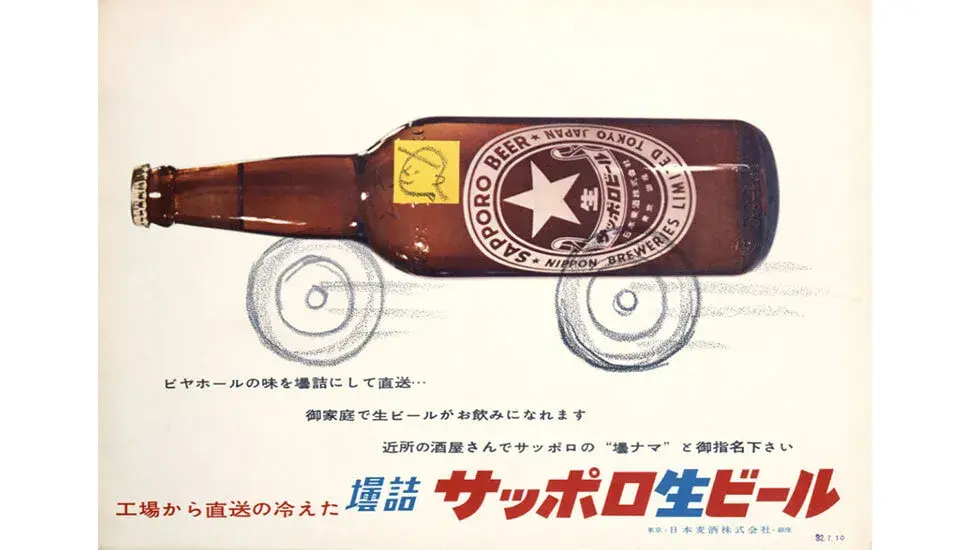
A 1957 poster for “Sapporo Bottled Draft Beer”
The key to success in bottling draft beer was a filtration technology that completely removed the yeast from the beer once its role was complete. Using a ceramic filtration system featuring a proprietary ceramic filter, the engineering team succeeded in bottling the draft beer while preserving its full flavor.
This led to the creation of “Sapporo Bin-Nama,” which was launched nationwide in 1977. The history of “Sapporo Draft Beer Kuro Label” begins here. At the time, the striking black Label made it widely known by the nickname “Kuro(black) Label.”
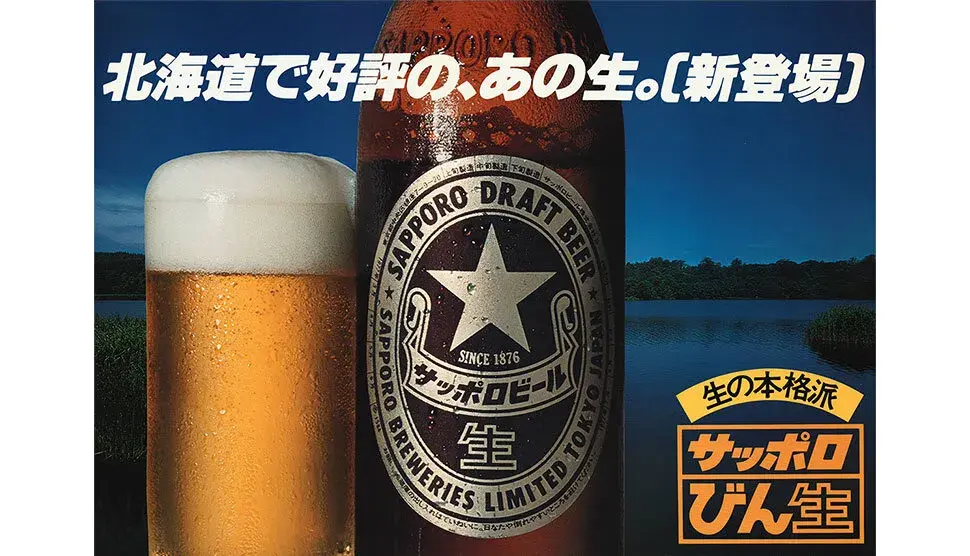
A 1977 poster for "Sapporo Bin-Nama"
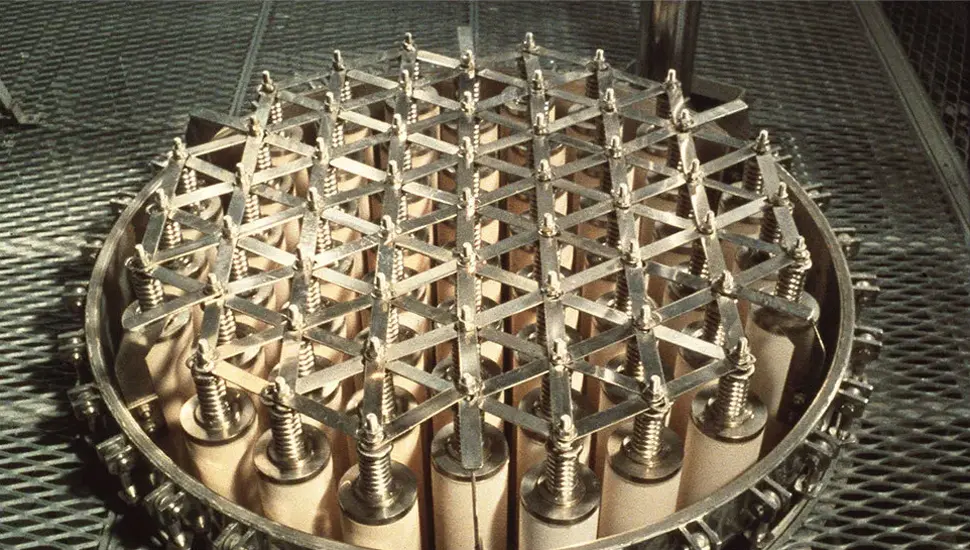
The ceramic filter developed independently by Sapporo Breweries
Entry into the wine business
While maintaining the beer business as its core, the company also moved forward with expansion into new business areas. In the 1970s, although the Japanese wine market was still small, significant growth was anticipated due to the gap in consumption levels compared to Europe and the United States.
The company officially decided to enter the wine business in 1974, and in January 1977, it changed the name of the acquired Marukatsu Wine Co., Ltd. to “Sapporo Wine Co., Ltd.”In May of the same year, we launched “POLAIRE” as our first in-house brand. This wine was produced using the “Cooled Winery System,” which applied temperature control technologies cultivated through beer brewing to enable low-temperature fermentation, storage, and bottling. This system offered advantages such as preventing wine oxidation and suppressing the volatilization of aromatic compounds, thereby providing quality assurance for the product.
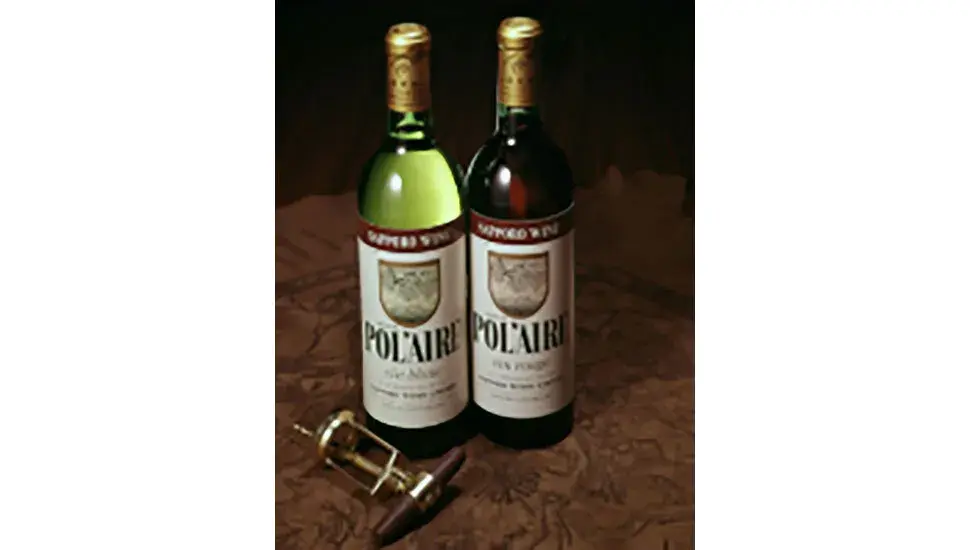
Sapporo Wine “POLAIRE”
The Birth of the New Beer Barley Variety "Haruna Nijo"
A significant achievement emerged in the development of ingredients that underpin beer quality. In 1978, following many years of breeding research, a new variety of high-quality, early-maturing beer barley called “Haruna Nijo” was developed. This variety was highly acclaimed both domestically and internationally and came to be widely used as a parent stock for beer barley breeding.Subsequently, we continued to develop excellent varieties such as “Tsuyushirazu” (1984) and “Tone Nijo” (1989), thereby strengthening the ingredient foundation that underpins beer quality.
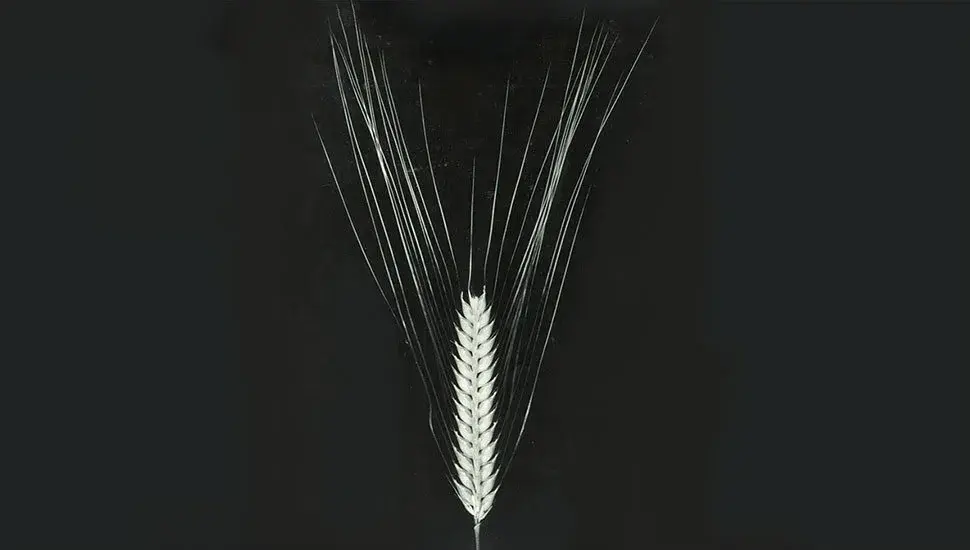
Beer Barley “Haruna Nijo”
Expansion into Overseas Markets
Once the draft beer strategy gained traction domestically, the company began a full-scale expansion into overseas markets, particularly the U.S. market.In 1980, the company launched the large-format (633ml) bottle of “Sapporo Bin Nama” in the U.S. market. At the time, the mainstream size for imported beer in the U.S. was 12 ounces (355ml), making large-capacity bottles a rarity. Although preliminary market research yielded unfavorable results, the company saw potential for success in the product’s uniqueness and decided to proceed with the launch.
This decision paid off. Coupled with a local Japanese food boom, the distinctive bottle and flavor were well-received by consumers, leading to a significant increase in sales volume.Building on this success, the company established its local subsidiary, “SAPPORO U.S.A., INC.,” in July 1984 and expanded its sales network across the United States. Bolstered by the success of “Sapporo Cup Draft,” launched that same year, the company went on to secure the top share of U.S. beer exports among Japanese brewers by 1985.
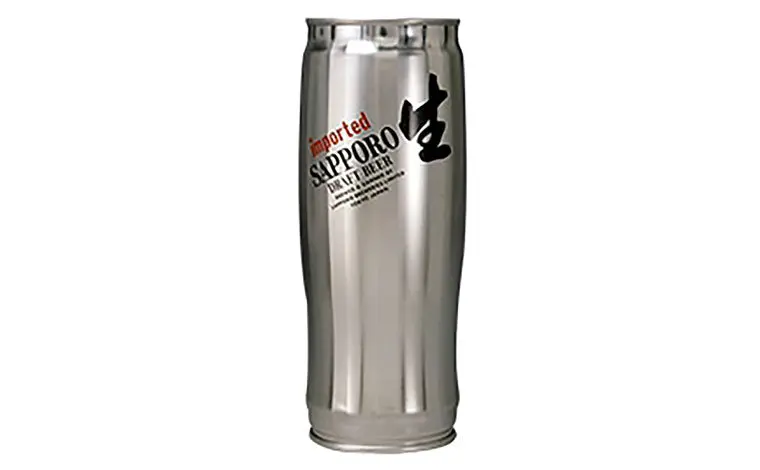
"Sapporo Cup Nama" (650ml can)
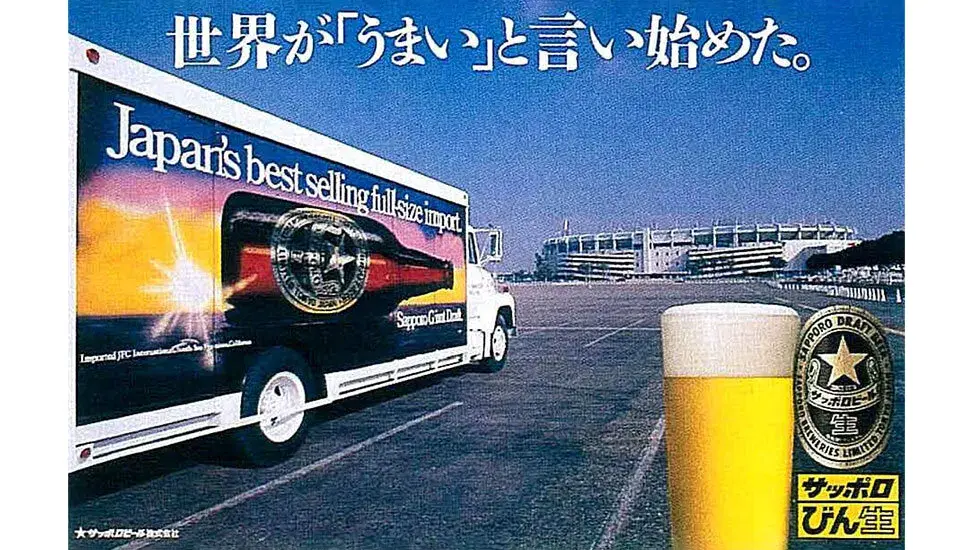
A 1986 poster for "Sapporo Bin Nama"
New Strategy for the Domestic Market
In the domestic market, the company launched a new strategy to meet the diversifying needs of consumers. In June 1985, it released 『SAPPORO CLASSIC』 a 100% malt draft beer, exclusively in the Hokkaido region. Developed to suit Hokkaido’s climate and food culture, it is characterized by a slightly bitter taste. This product, developed specifically for a particular region, was a success and established a new category of region-exclusive products.
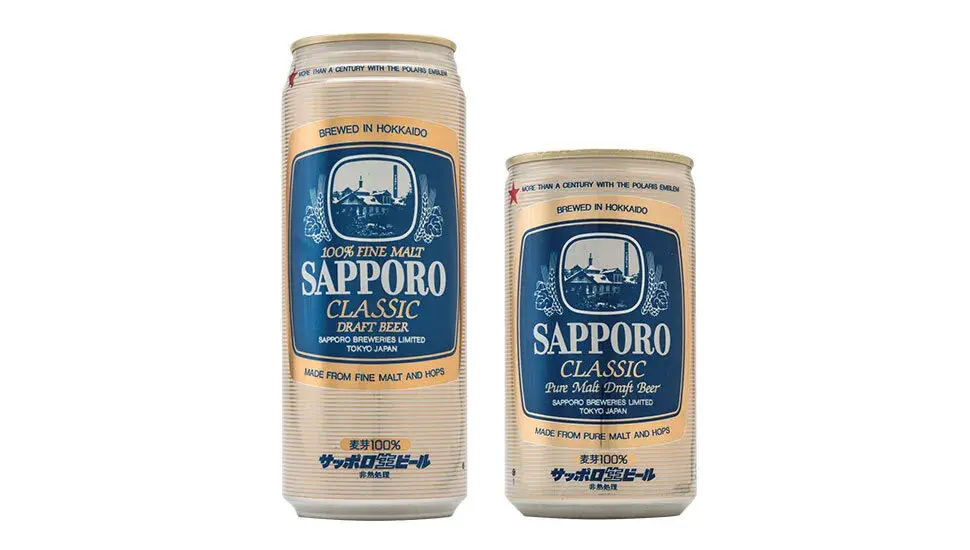
『SAPPORO CLASSIC』 (500ml can, 350ml can)
In October 1988, the company launched “Sapporo Fuyu Monogatari,” Japan’s first winter-limited edition beer. Based on the concept of “a beer fit for winter,” this product featured a slightly higher alcohol content of approximately 5.5%, and its name was taken from a Shakespearean play. This product also pioneered the new genre of seasonal limited-edition beer.
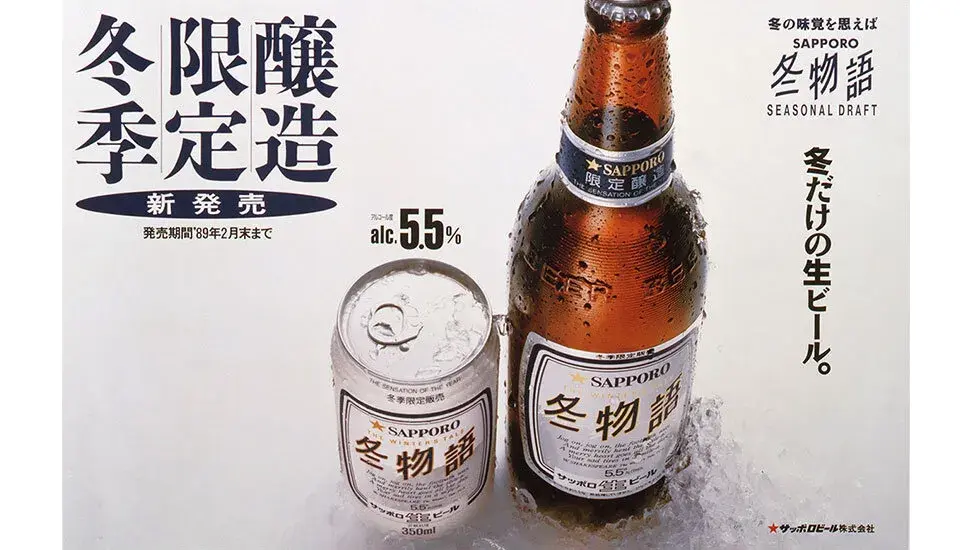
"Sapporo Fuyu Monogatari" poster
The Creative Roots Carried Forward by Sapporo and Ebisu
As the business grew, efforts were made to preserve corporate culture and reorganize production systems.In 1987, the “Sapporo Beer Museum” opened in Sapporo as Japan’s only museum dedicated to beer. This facility preserves and utilizes the brick building of the former Sapporo Sugar Company, constructed in 1890, and is a structure of high historical value that has been designated as a Hokkaido Heritage site. As a valuable venue chronicling the history of Japan’s beer industry, it has come to symbolize the fusion of corporate history and local culture.
Meanwhile, the Ebisu Plant, established in 1889, grew alongside the times. However, as urbanization progressed in the surrounding area and left no room for expansion, it closed its doors after approximately 100 years of history. Production operations at the plant were transferred to the state-of-the-art Chiba Plant (Funabashi City, Chiba Prefecture), which was completed in 1988. The memories of Sapporo and Ebisu continue to live on, evolving into new forms as part of our mission for the future.
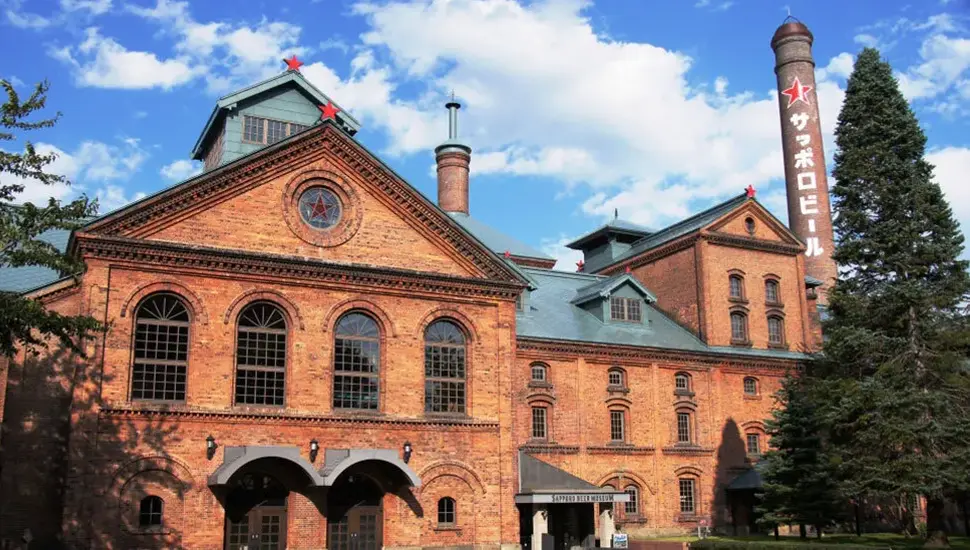
Sapporo Beer Museum
Part 7: Toward Diversified Management—Sapporo’s New Era
1989–1995
“Sapporo Draft Beer Kuro Label”: Named by Our Customers
We launched “Bin-Nama” in 1977 (Showa 52) and pioneered the draft beer market, but the market changed dramatically when the “Dry War” broke out in the beer industry in 1988. As various companies released dry-style draft beers that attracted attention, the presence of “Bin-Nama” (and “Can-Nama” for cans) began to fade.
Consequently, in February 1989, we launched “Sapporo Draft,” completely revamping not only the name and label but also the product itself. We featured musician Ryuichi Sakamoto in our advertisements to appeal to younger consumers. However, this relaunch elicited an unexpected reaction: we began receiving numerous requests for the “Bin-Nama” to be brought back. In particular, calls for the revival of “Bin-Nama” grew louder among customers in their 40s and 50s.In response to these calls, we decided to bring it back just six months later, in September. At that time, rather than using “Bin-Nama,” we adopted “Sapporo Draft Beer Kuro Label”—the nickname customers had affectionately used for many years—as the official name, launching “Sapporo Kuro Label.”
The relaunched Sapporo Draft Beer Kuro Label was warmly welcomed and quickly regained its position as one of our core products. Sales steadily increased, revitalizing our beer business and serving as an opportunity to reaffirm the brand’s value. Today, Sapporo Draft Beer Kuro Label is a powerful driving force behind our beer business.
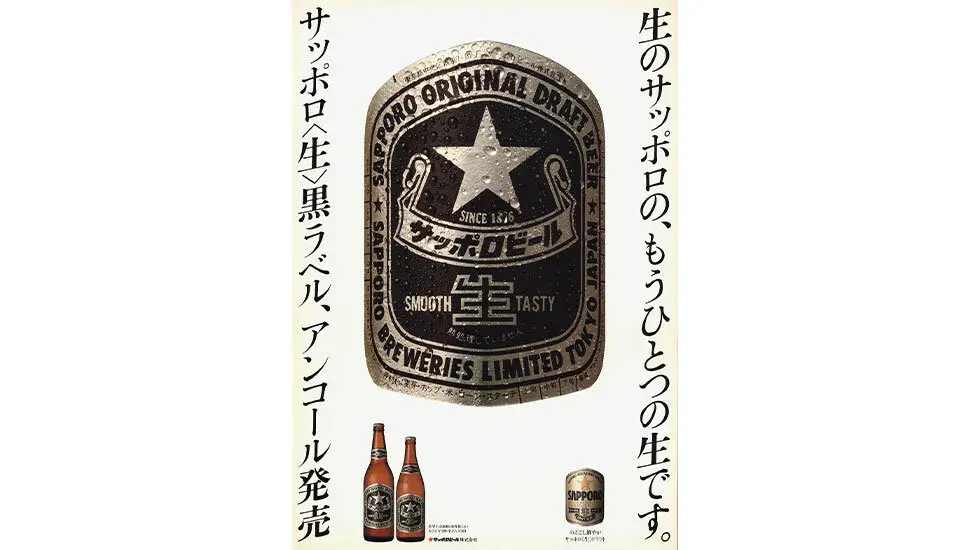
Poster for "Sapporo Draft Beer Kuro Label"
The Challenge of Diversified Management Centered on Beer
With the beer business accounting for over 90% of our revenue, we strongly recognized the importance of diversified business operations. Although we had expanded into various fields such as Soft Drinks / Beverages, real estate, and wine and spirits, we formulated a policy aimed at establishing a second pillar to rival the beer business.
The concept devised as a breakthrough was the creation of “small cities.” This was the first step in realizing our “diversified business” vision, and urban development projects were launched in accordance with the basic Management Policies of “promoting a diversified business centered on beer.” At the core of this were the redevelopment projects for the former sites of the “Sapporo Plant (Sapporo City, Hokkaido)” and the “Ebisu Plant (Shibuya Ward, Tokyo).”
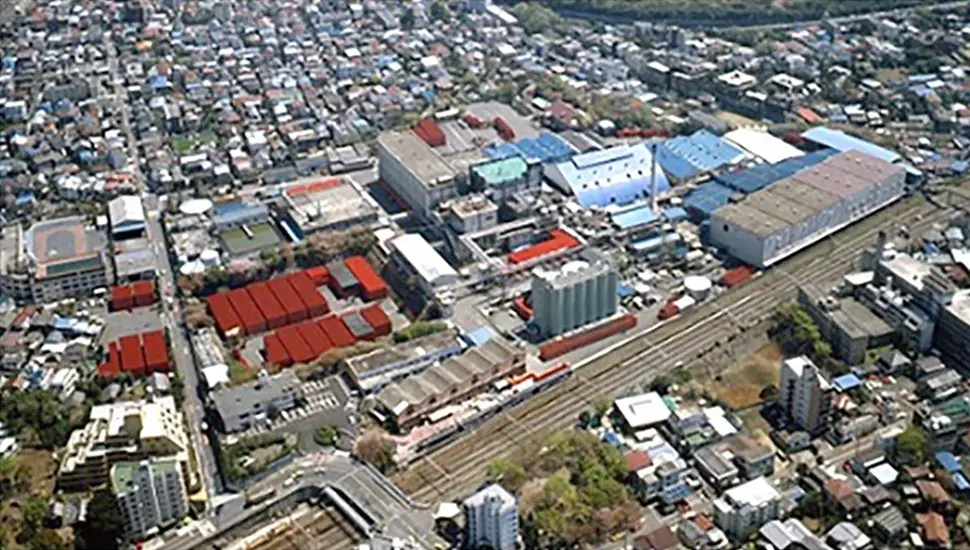
The "Ebisu Plant" around 1985
Bringing New Vitality to Sapporo
Sapporo Breweries had two production facilities in Sapporo: Plant No. 1 and Plant No. 2. Plant No. 1, in particular, had continued production since its opening in 1876 as the Kaitakushi Beer Brewery, making it Japan’s oldest beer factory. However, due to aging facilities and the urbanization of the surrounding area, we decided to discontinue operations there and relocate to a new plant in Eniwa City. The Sapporo Breweries Hokkaido Plant (Eniwa City) was completed in 1989.
Consequently, the redevelopment of the site of the Sapporo Plant No. 1 was planned as a mixed-use urban redevelopment project aimed at offering citizens a new lifestyle and culture. On April 9, 1993, it was reborn as “Sapporo Factory” (Higashi Ward, Sapporo).A mixed-use commercial complex with a floor area of approximately 122,500 m² was built on the 41,200 m² site, creating Sapporo’s first groundbreaking facility that integrated retail, dining, entertainment, hotels, and theaters.With the concept of “A New Life in the North,” the project aimed to revitalize the Sosei River East District while preserving the red brick buildings and chimneys that carry on the legacy of the Hokkaido Development Commission Brewery.
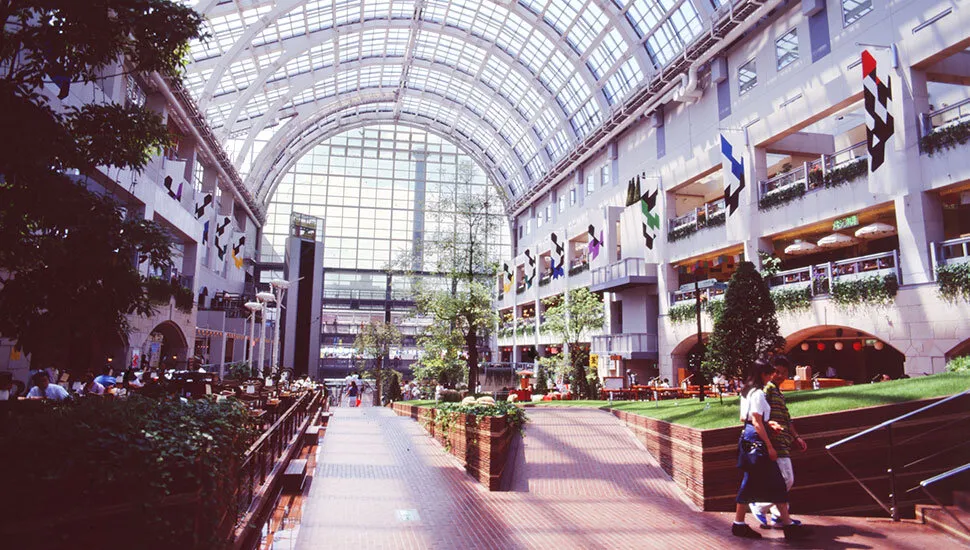
The Atrium Park at "Sapporo Factory"
"Yebisu Garden Place," born after more than a decade of planning
The Ebisu Plant, another core element of the "promotion of integrated management centered on beer," was completed in 1889 and underwent repeated expansions. However, due to its location in a densely populated urban area, combined with aging facilities and rapidly changing logistics conditions, there were limits to further expansion to meet growing beer demand.
In parallel with these developments, the Tokyo Metropolitan Government began surveying an area of approximately 1.1 million square meters stretching from JR Yamanote Line Ebisu Station to Meguro Station in 1983, compiling the “Basic Survey Report on the Ebisu District Development Plan” the following year. Based on this report, the “Comprehensive Development Promotion Project for Specified Residential Urban Areas” was applied to the redevelopment of this region.In response to the local redevelopment plan and with an eye toward future business expansion, the Ebisu Plant concluded its nearly 100-year service, and it was decided to relocate to a new facility in Funabashi City, Chiba Prefecture.
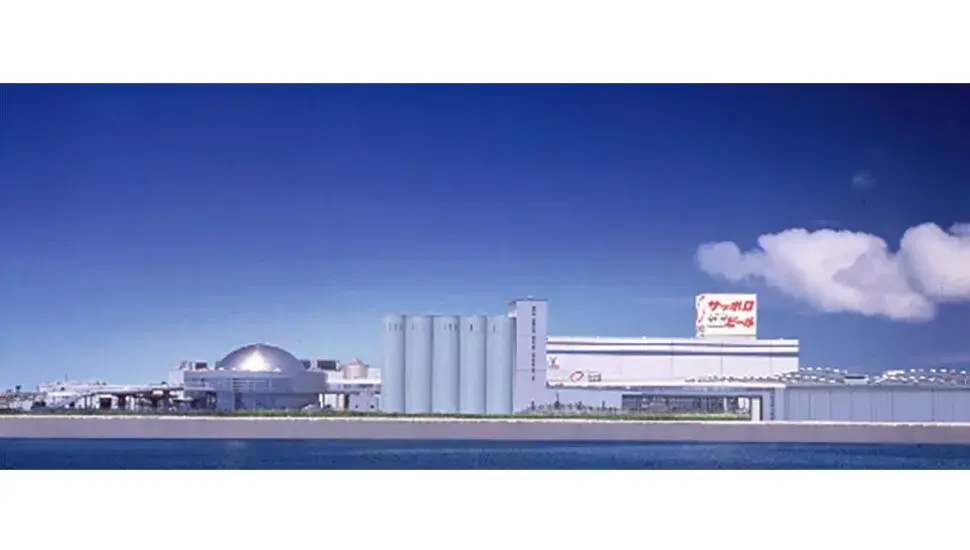
The "Chiba Plant," completed in 1988
On the site of the former factory, "Yebisu Garden Place" was born, embodying the vision of a "Yamanote Information and Cultural City of Water and Greenery." It features a spacious environment where approximately 60% is open space, with residential units, hotels, and commercial, dining, and cultural facilities integrated throughout. As a pioneer of mixed-use urban development, it opened on October 8, 1994.It attracted so much attention—including approximately 150,000 visitors on its grand opening day—that it became a social phenomenon, solidifying the cornerstone of the integrated business model our company strives to achieve. The site of the "Yebisu Beer Brewery," which gave the "Yebisu" neighborhood its name, was reborn as "Yebisu Garden Place" more than a decade after the initial concept was conceived, continuing to cultivate a sophisticated image for the surrounding area.Today, it has become such a popular neighborhood that it consistently ranks at the top of “most desirable places to live” lists.
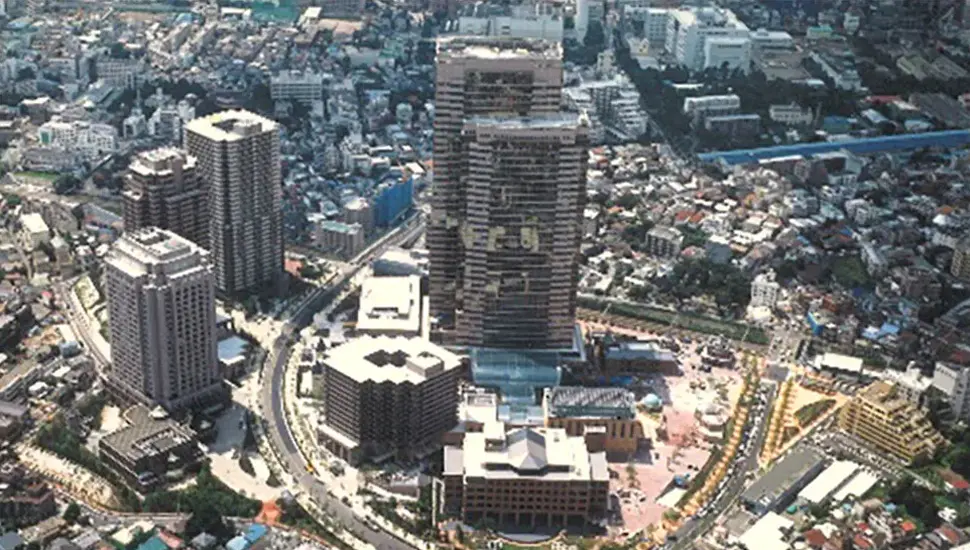
"Yebisu Garden Place" as seen from the sky