Sapporo Group's Core Technologies
Sapporo Breweries' Core Technologies
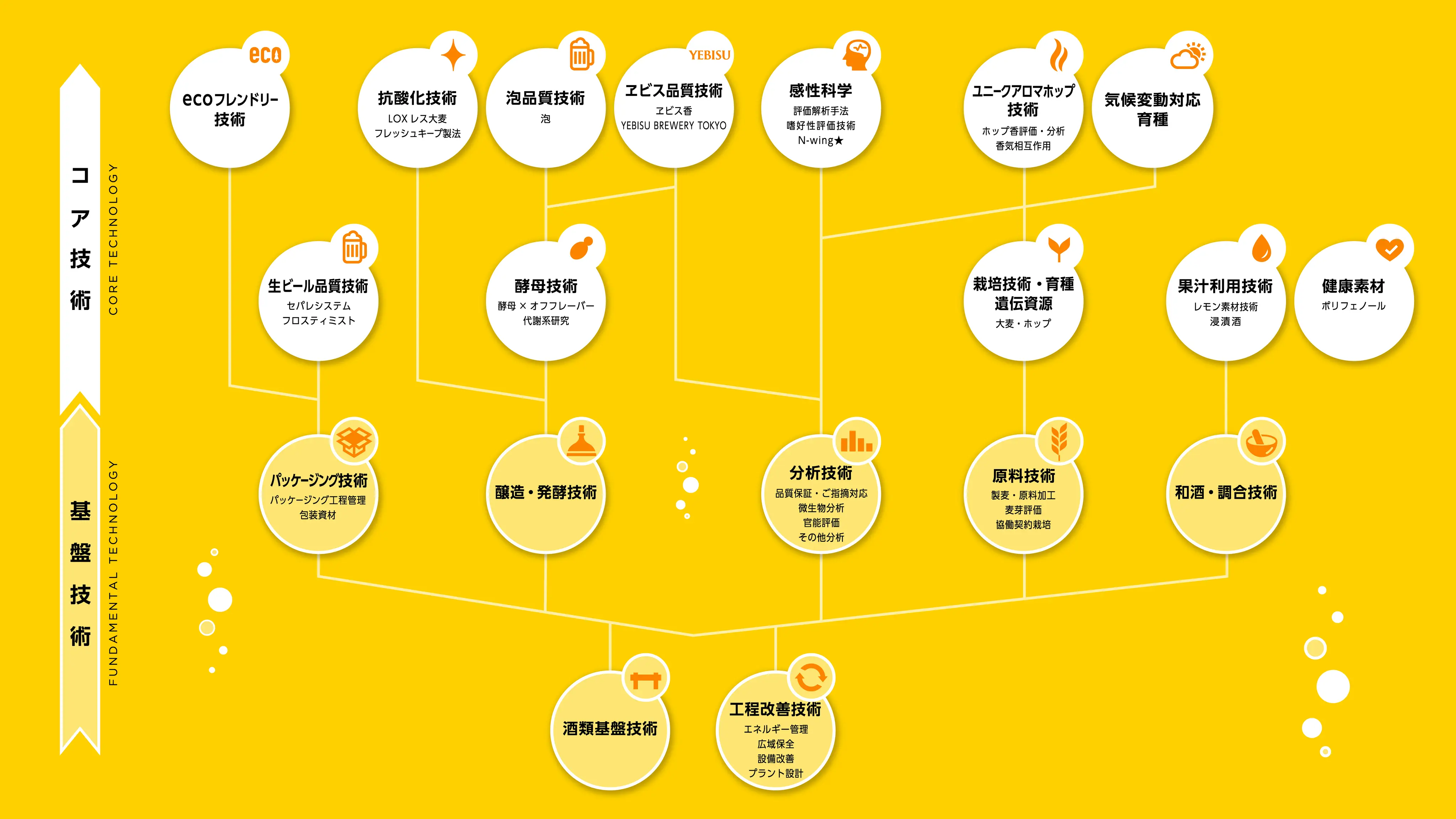
Core Technology Map
We have classified and organized Sapporo Breweries’ R&D domains to create a Core Technology Map. We have identified Sapporo Breweries’ strengths in R&D—derived from foundational technologies such as raw materials, brewing and fermentation, Japanese spirits and blending, analysis, and packaging—as core technologies. Moving forward, we aim to create future value by deepening and expanding these core technologies and technical domains.
Cultivation Technology, Breeding, and Genetic Resources
Since our founding in 1876 (Meiji 9), we have been engaged in the cultivation and variety development of barley and hops. In the field of barley, starting with “Haruna Nijo,” we have long contributed to improving the quality and ensuring stable production of domestic beer barley. Currently, barley varieties developed by Sapporo Breweries are cultivated in Japan and Canada, and these varieties are used in part as malt for Sapporo Breweries products under the brand name “Long-Lasting Flavor Malt.” Furthermore, utilizing Japan’s largest genetic resources for hops, we have developed new varieties with excellent aroma and bitterness, which have been registered both domestically and internationally.
Unique Aroma Hop Technology
We have developed numerous hop varieties with unique aromas (Unique Aroma Hops), which are currently undergoing trial cultivation or commercial production both domestically and internationally. Some of these Unique Aroma Hops are used not only in products from Sapporo Breweries but also widely around the world. Furthermore, our R&D achievements aimed at improving hop quality—including hop variety development and the development of analytical methods for hop aroma compounds—were recognized with the Agricultural Chemistry Technology Award in 2018.
Breeding for Climate Change Adaptation
We have begun developing new varieties of barley and hops capable of undergoing climate change adaptation, including global warming, and aim to file for the registration of varieties that have undergone climate change adaptation (barley and hops) by 2030. By commercializing these varieties, we aim to contribute to the beer industry—including barley and hop producers and raw material suppliers—and achieve sustainable raw material procurement.
Antioxidant Technology
Based on research elucidating the mechanisms of beer quality deterioration, we developed an antioxidant manufacturing method, optimized brewing equipment and process operations, and established the “Fresh Keep Method”—a technology that significantly improves beer quality. Furthermore, the lipid oxidation mechanisms during the brewing process elucidated through this research served as the foundation for the development and commercialization of “Long-Lasting Flavor Malt” (LOX-free (free from liquid oxygen)).Our research achievements, ranging from the theoretical elucidation of beer quality deterioration to its practical application, were recognized with the Agricultural Chemistry Technology Award in 2000, while the development of the LOX-free (free from liquid oxygen) barley variety—the raw material for "Long-lasting Flavor Malt"—received the Japanese Society of Plant Breeding Award in 2015.
Yeast Technology
Yeast plays a central role in the beer brewing process and has a significant impact on the flavor and aroma of beer. To brew beer with the exact quality we design, we are constantly refining our techniques to select yeast with desirable characteristics and maintain it in optimal condition.
Foam Quality Technology
We continue to conduct dedicated research on foam quality at every stage of the process, from raw material procurement, brewing, and packaging to distribution and serving. Our research achievements have been recognized with the Excellence Award at the All-Japan Packaging Technology Research Conference in 2003, the Encouragement Award from the Japanese Society of Plant Breeding in 2014, the Agricultural Chemistry Technology Award in 2015, and the Technical Award from the Japan Brewing Association in 2017.
Yebisu Quality Technology
Since our founding in 1890, we have been committed to authentic flavor and have continued to refine it.
Today, we continue to conduct R&D on the flavor and aroma of Yebisu Beer through comprehensive efforts that leverage the knowledge and technology passed down for over 100 years, as well as yeast technology, analytical techniques, and sensory science.
Sensory Science
To evaluate the deliciousness of food and beverages, it is necessary not only to understand the internal components—such as beer ingredients—but also to understand how the consumer perceives and reacts to them. We continue to conduct research using physiological and psychological approaches to evaluate and analyze the sensory perceptions of deliciousness.
We have launched ready-to-drink (RTD) recipe development through human-AI collaboration, enabling new product development that creates flavors based on taste concepts.
Fruit Juice Utilization Technology
We are conducting R&D to widely utilize our proprietary macerated spirits and Pokka Sapporo Food & Beverage’s unique lemon ingredients in alcoholic beverages, including ready-to-drink (RTD) products.
Health Ingredients: Polyphenols
In addition to grapes with high polyphenol content, we are engaged in raw material research and development aimed at creating new value propositions for polyphenols.
Draft Beer Quality Technology
Beer’s fine foam not only provides a smooth mouthfeel but also acts as a lid on the surface of the liquid, helping to preserve the flavor, aroma, and refreshing sensation for longer. Through the development of Sapporo Breweries’ proprietary draft beer systems—such as the Separe System and Perfect Karan—we have realized our commitment to delivering draft beer quality, including the ideal foam and “frosty mist” characteristic of draft beer.
Eco-Friendly Technology
With the goal of reducing packaging materials (through lightweighting and simplification), we launched the "eco-friendly" next-generation container and packaging project in 2023. We continue our efforts to develop environmentally conscious containers and packaging that significantly reduce paper usage.