A 150-Year Journey
*This page lists major events from our founding in 1876 through 1995.
Information covering 1996 and beyond will be published as soon as preparations are complete.
Part 4: The Breakup of Dainippon Beer and the Launch of Nippon Beer
1949–1963
Postwar Turbulence and the Breakup of Dai-Nippon Beer
With the end of the war in 1945 (Showa 20), economic democratization was vigorously promoted in Japan under the guidance of the GHQ (Supreme Commander for the Allied Powers), including the dismantling of zaibatsu conglomerates and the enactment of the Antimonopoly Act.Amid these sweeping changes, Dainippon Beer, which held an overwhelming share of the domestic beer market, could not avoid being designated under the “Act for the Elimination of Excessive Concentration of Economic Power.” Consequently, in September 1949, it was split into two companies: “Nippon Breweries Ltd.” and “Asahi Breweries Ltd.” This brought a close to 43 years of history, and the Japanese beer industry entered a new era.
As a result of this split, our company made a fresh start as “Nippon Breweries”. This marked the birth of the new Nippon Beer. While we inherited five breweries—in Sapporo, Kawaguchi, Meguro, Nagoya, and Moji—the distribution of these facilities was uneven, leaving gaps in coverage across the country. In particular, the Kansai market remained a blank spot, resulting in a difficult start fraught with sales challenges.
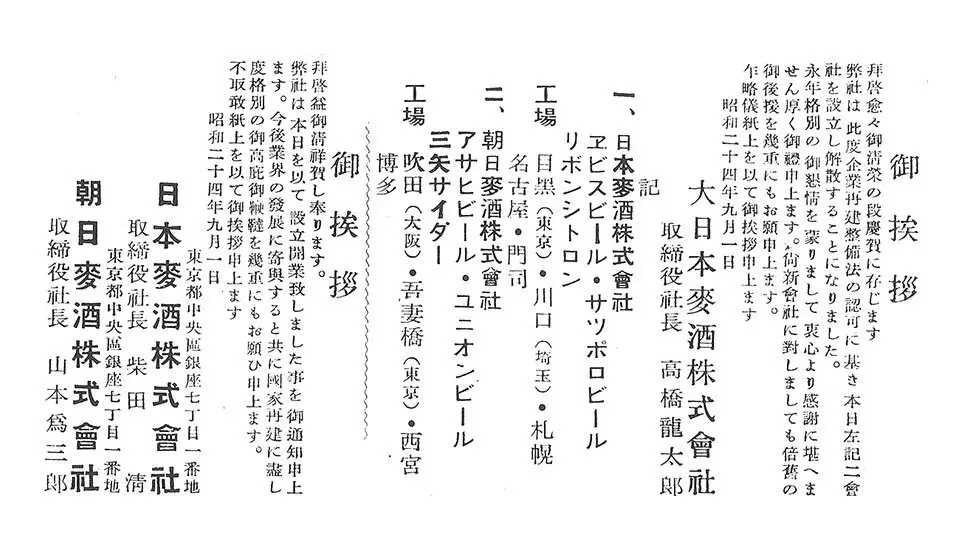
Greeting Letter on the Dissolution of "Dainippon Beer Company" and the Establishment of “Nippon Breweries Ltd.” and “Asahi Breweries Ltd.”
Building a New Brand, Not Reviving Yebisu or Sapporo
In May 1949, restaurants and bars were permitted to reopen; in Tokyo, operations began in June, and the industry gradually regained its vitality. In December of the same year, companies abolished the unified trademark “Beer” used during the war and revived their own unique Brands. While Asahi Beer and Kirin Beer revived trademarks familiar to the public from before the war, our company was forced to make a major decision.
The two inherited brands, “Yebisu” and “Sapporo,” enjoyed immense popularity in their respective regions—Hokkaido and the Kanto region—but had their pros and cons as national brands. With a view toward nationwide expansion, we launched a new brand, “Nippon Beer,” which aligned the company name with the product name, rather than relying on the inherited brands.Although the star logo was inherited from the “Sapporo” brand, the new “Nippon” brand, unfamiliar to consumers, struggled to gain traction in the market, and its market share continued to decline year after year. During this period, we poured resources into advertising and promotion, but regaining momentum proved difficult.
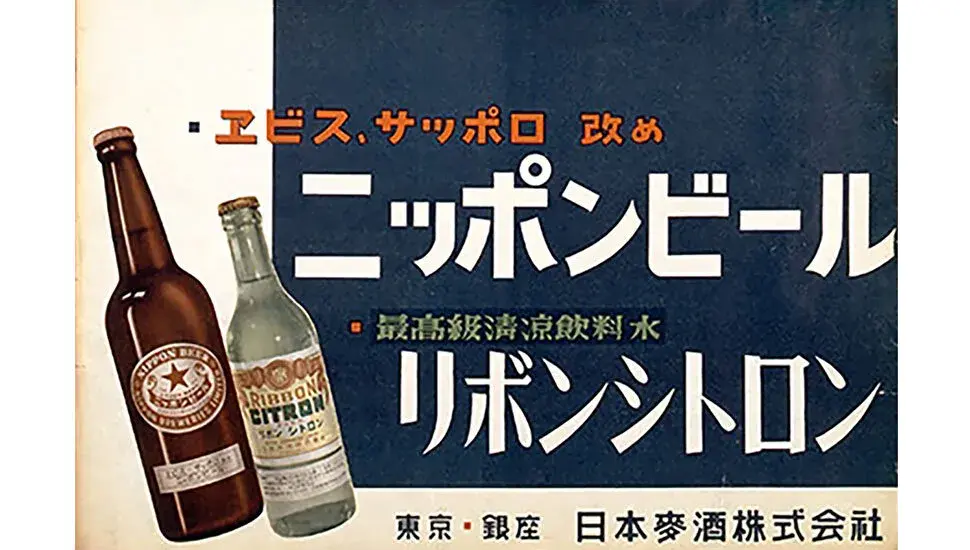
"Nippon Beer" poster
A Ray of Hope in the Northern Lands: The Revival of Sapporo
As "Nippon Beer" continued to struggle, calls within the company—particularly from the sales front lines—grew louder by the day for the revival of the traditional "Sapporo" brand. In March 1956, to commemorate the 80th anniversary of the Sapporo Plant, "Sapporo Breweries" was relaunched for the first time in 13 years, exclusively in Hokkaido, its birthplace.
Bolstered by the enthusiastic support of Hokkaido locals who had long awaited its return, “Sapporo Beer” saw phenomenal sales, and the Hokkaido beer market was instantly dominated by Sapporo Beer.The Tokyo headquarters conducted market research on both the "Nippon" and "Sapporo" brands. The results revealed that while "Nippon" was popular among younger consumers, its appeal was limited among those in their 40s and older; conversely, "Sapporo" enjoyed high name recognition and positive reviews across all age groups. This served as a major stepping stone toward the nationwide revival of Sapporo Beer.
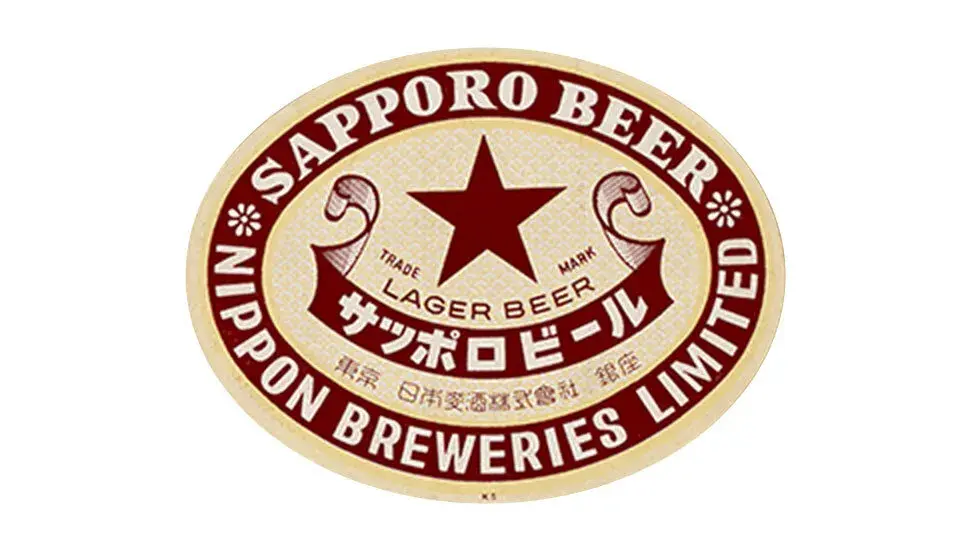
The "Sapporo Beer" Revival Label in Hokkaido
Sapporo Returns Nationwide with New Momentum
After preparations including market research and a redesign of the product’s quality, “Sapporo Beer” was relaunched nationwide in February 1957. Although it initially went on sale alongside “Nippon Beer,” consumer preference quickly shifted to Sapporo Beer, and production began at all factories. Within just one year, it accounted for two-thirds of the company’s total beer shipments.
Nippon Beer, formed after the postwar breakup of Dainippon Beer, launched under the new brand name “Nippon Beer,” but struggled to gain traction with consumers. However, the decision in 1956 to revive Sapporo Beer in Hokkaido and expand it nationwide marked a turning point for the company. It demonstrated the importance of consumer-oriented approaches and the necessity of technological innovation, laying a solid foundation for the future growth of Sapporo Beer.
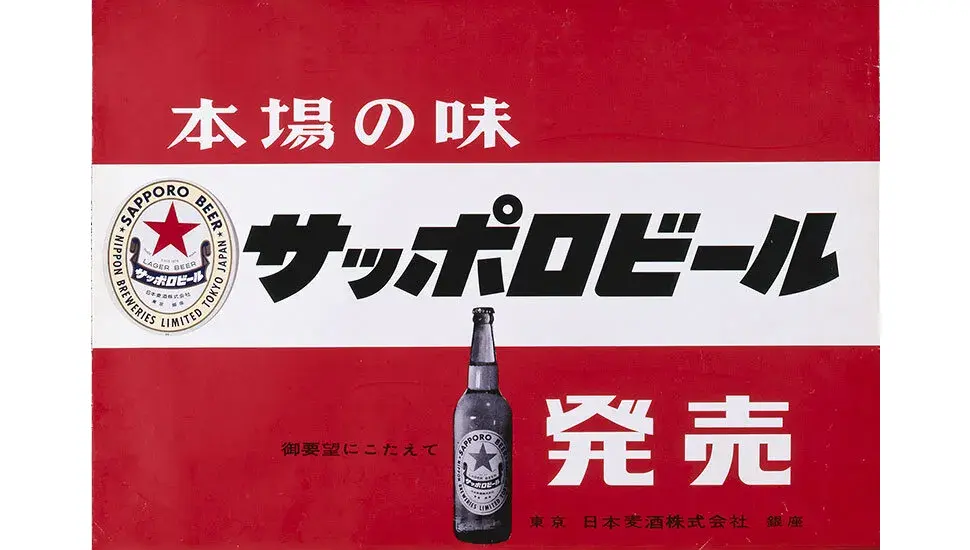
Poster from the nationwide relaunch
Resumption of Advertising Activities
With the use of trademarks—which had been banned during the war—permitted again in 1949, advertising activities in the beer industry resumed. A particularly notable example of “Nippon Beer” advertising is the 1954 “King of Beer” campaign. This series of advertisements, featuring an illustrated character created by the then-up-and-coming manga artist Takashi Yanase, represented a departure from conventional approaches and garnered attention for its cohesive creative style.
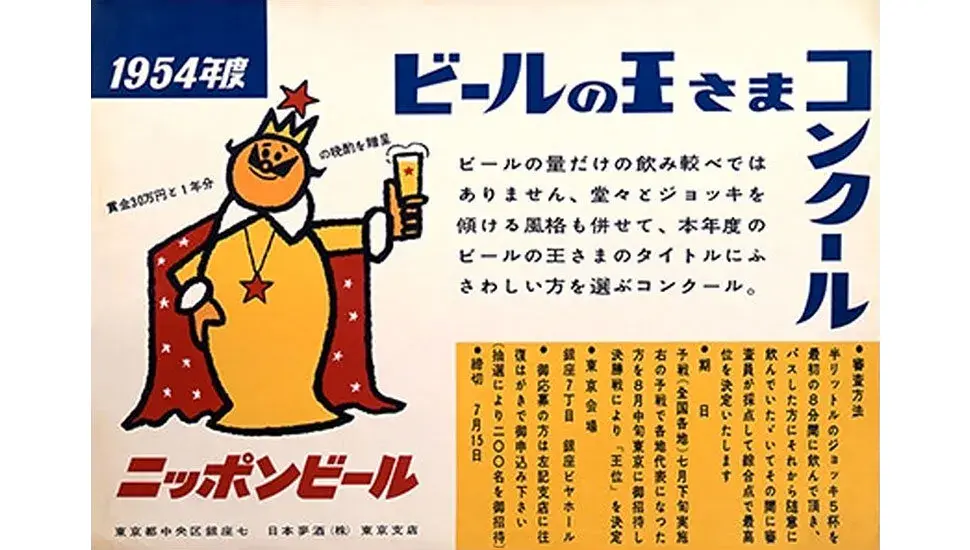
"King of Beer" poster
Furthermore, with the revival of “Sapporo Beer” in 1957, advertising shifted to emphasize “authentic flavor.” This concept was brought to life in the 1958 “Munich, Sapporo, Milwaukee” advertisement.At a time when unrestricted overseas travel was not yet permitted, the catchphrase linking the world’s three major beer-producing regions at 45° north latitude was both innovative and compelling, generating a huge response. It strongly reinforced the corporate image that Sapporo stood shoulder-to-shoulder with the world’s premier beer-producing regions.
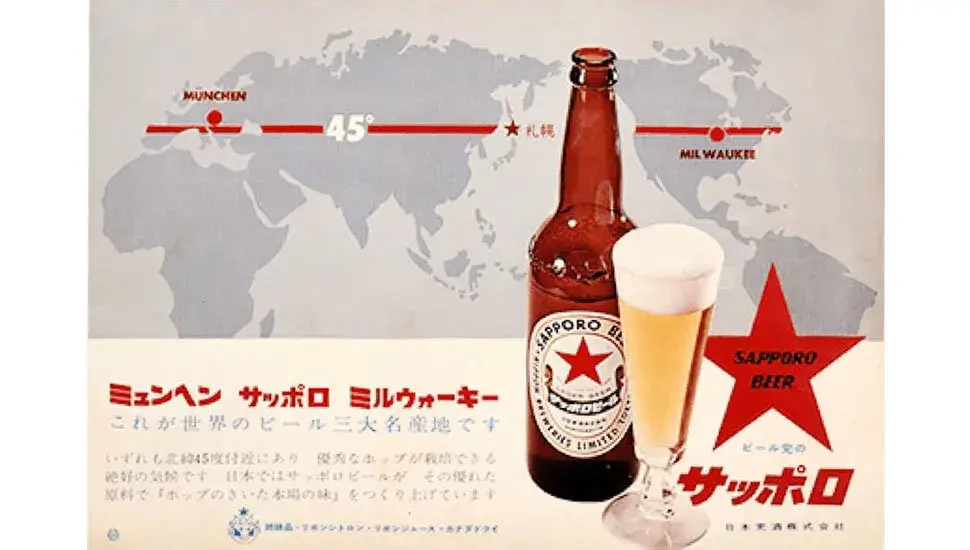
"Munich-Sapporo-Milwaukee" poster
Part 5: Name Change—The Rebirth of Sapporo Breweries
1964–1976
88 Years with the ★ Mark
In the 1960s, Japan hosted the Tokyo Olympics, transitioned to Article VIII status with the IMF (International Monetary Fund), and joined the OECD (Organization for Economic Cooperation and Development), growing into the world’s second-largest economy by GNP during the “Izanagi Boom.”Domestic Alcoholic Beverages demand accounted for approximately 40% of total alcoholic beverage shipments in 1959 (Showa 34), surpassing sake to become the top-selling product. Within the industry, new product development became active, and competition among companies intensified.
On January 1, 1964, the company changed its name from Nippon Breweries Ltd. to Sapporo Breweries Ltd. and relocated its head office from Meguro Ward, Tokyo, to Ginza, Chuo Ward. Fifteen years after the split of Dainippon Beer, the company decided to align its product name with its corporate name, centering on the revived “Sapporo Beer.”
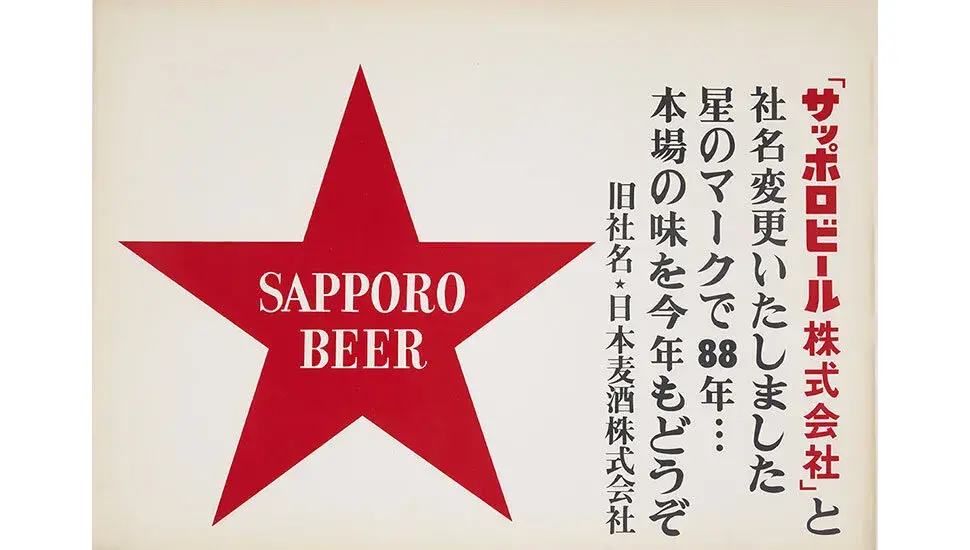
Poster announcing the name change
The success of the extra-large “Sapporo Giants” (1,957 ml), launched the previous year, provided strong support for the new company name’s debut. Furthermore, to coincide with the name change in January 1964, commemorative neck labels bearing the inscription “New Company Name: Sapporo Breweries Ltd. ★ Mark for 88 Years” were affixed to shipped beer bottles, underscoring the arrival of a new era.
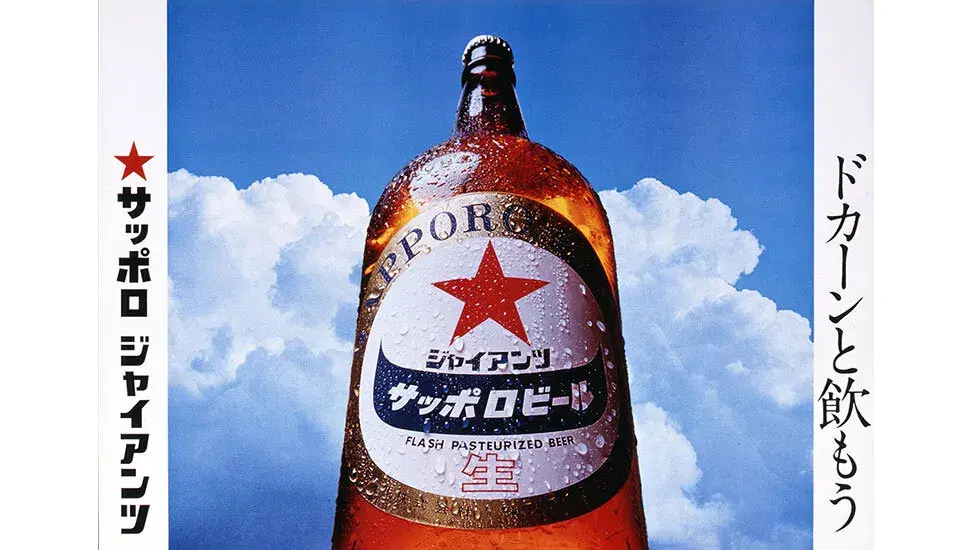
"Sapporo Giants" Poster
Intensifying Competition and Diversification Strategies
With its new name, Sapporo Breweries launched a succession of new products to meet diversifying consumer needs. In terms of packaging, the company released “Sapporo Strike” in 1965, the first beer in Japan to feature a “one-touch crown cap” that required no bottle opener. Its convenience won over consumers, and it became a hit product, selling approximately 1.8 million cases within three months of its launch.
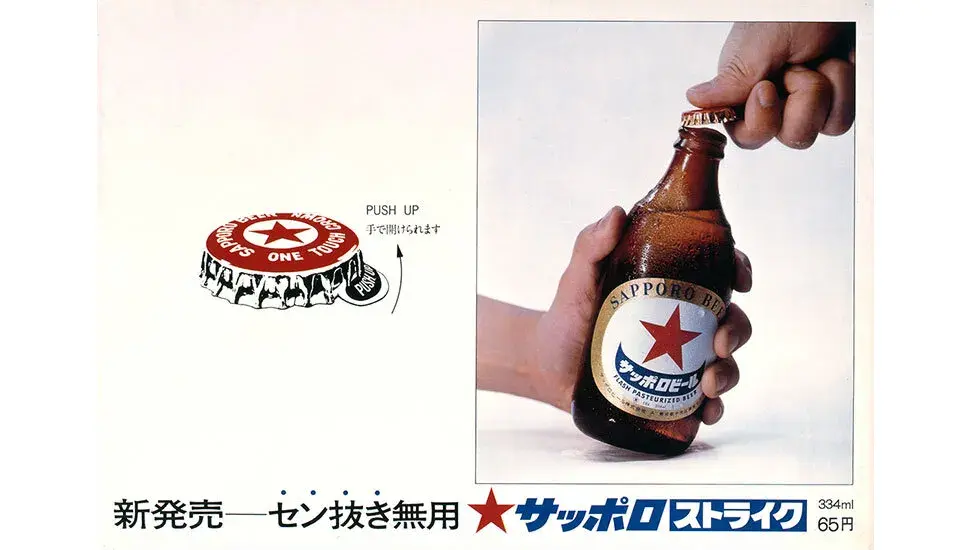
"Sapporo Strike" poster
Innovations in canned beer packaging also progressed, and in the same year, the company introduced the “pull-tab can,” which required no can opener.Starting in 1972, we introduced two-piece aluminum cans with an integrated base and body, which were more aesthetically pleasing and lighter than steel cans. Although the market penetration of canned beer had remained low at 1–2% for over 10 years since its launch, sales gradually increased due to changes in lifestyle and the spread of vending machines.
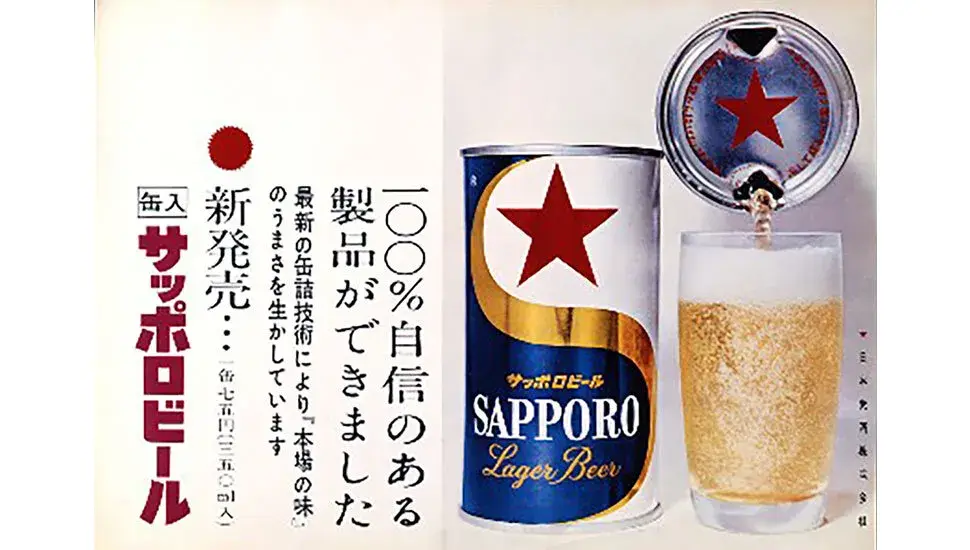
A poster for our first canned beer, “Sapporo Beer in a Can,” launched in 1959
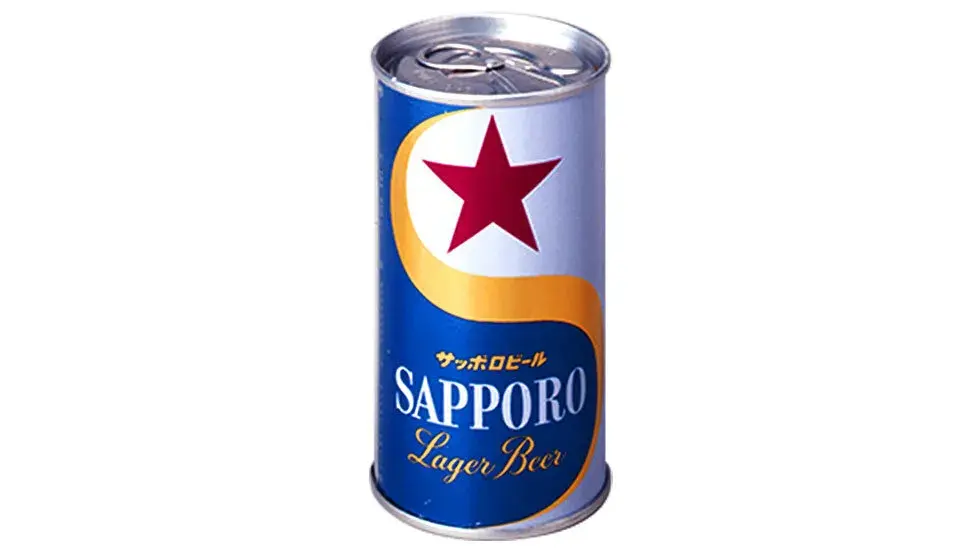
"Sapporo Beer in a Can" with a pull-tab, introduced in 1965
In terms of product development, we launched “Sapporo Five Star” (small bottle) in 1967, an authentic German-style beer characterized by a rich flavor achieved through a higher wort extract concentration. Its price, set 10 yen higher than standard beer, was considered groundbreaking in the industry at the time. In addition, we responded to growing beer demand with a diverse product lineup, including the launch of non-alcoholic beer and the introduction of distinctive imported beers.
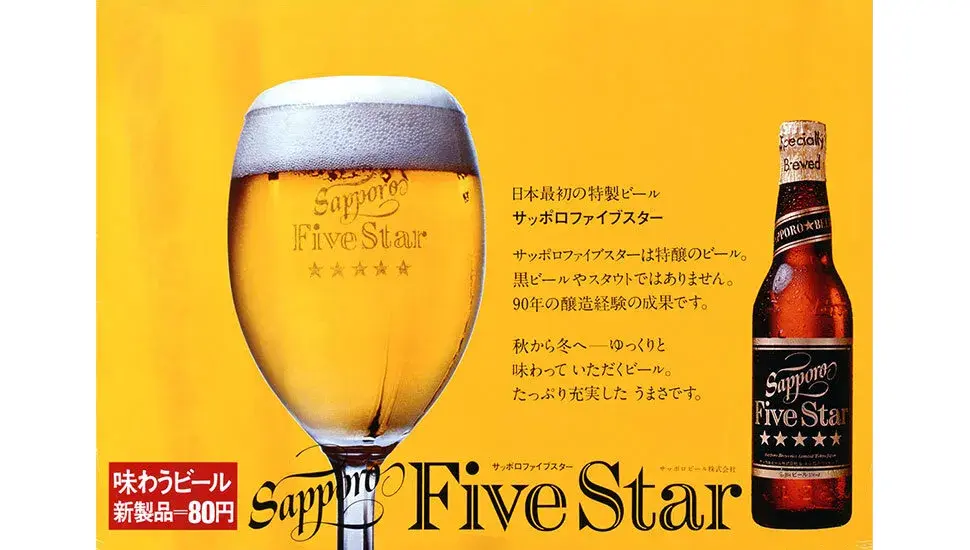
"Sapporo Five Star" poster
"A Man Drinks Sapporo Beer in Silence"
In 1966 and 1967, the Japan Consumer Association conducted a “Beer Taste Test” on two separate occasions. The test involved blind tastings of five domestic brands, and Sapporo Beer were selected as the top choice in both instances. This led to the organization of blind taste test events across the country.
Furthermore, in 1970, the company launched an advertising campaign featuring film actor Toshiro Mifune under the slogan “A Man Drinks Sapporo Beer in Silence,” seeking exposure across all media, including commercials and in-store posters. The poster design was simplified to the extreme, with no logo, body copy, or even a label.The TV commercials featured only music, with text scrolling across the screen—a truly “silent” advertisement. This silent campaign was a massive hit and took the nation by storm.
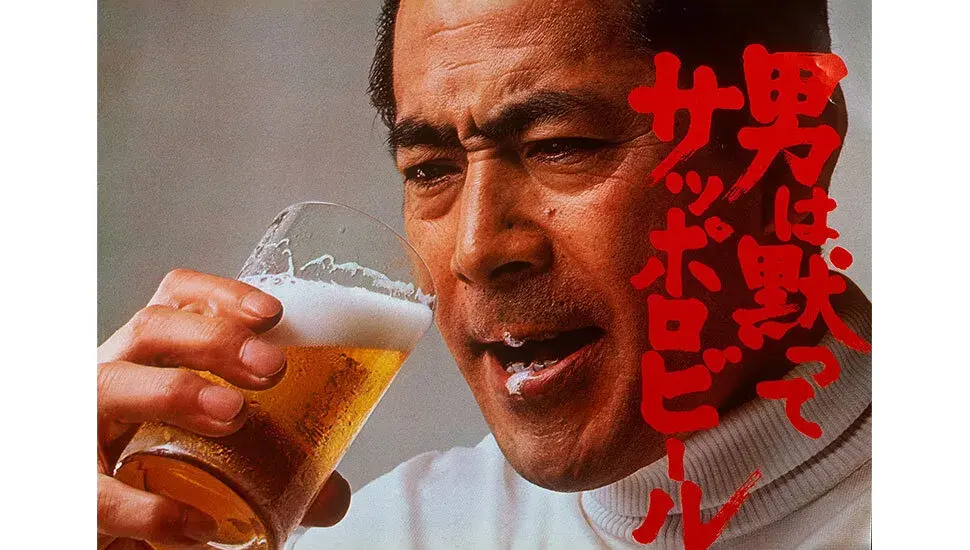
1970 "A Man Should Just Drink Sapporo Breweries" poster
"Yebisu Beer" Makes a Comeback After 28 Years
In December 1971, the popular pre-war brand “Yebisu Beer” was revived. This marked the first time in 28 years since all trademarks had been suspended in 1943 during the war.
For this revival, the technical team did not simply bring back the pre-war Brands; instead, they focused on commercializing a high-quality German-style beer.In Germany, the 1516 "Reinheitsgebot" (Beer Purity Law) prohibits the use of anything other than barley, hops, and water. Therefore, a German-style beer is a 100% malt beer that uses absolutely no secondary ingredients such as rice or corn. However, the technical team at the time had no experience brewing 100% malt beer. After extensive research, they finally achieved the first 100% malt beer in postwar Japan.
The advertising copy on the poster read: “A masterpiece. Now, reborn. Special Edition Yebisu Beer.” It gained immense popularity due to its exceptional quality. Prior to the launch of “Yebisu Beer,” the Meguro Plant was renamed the Yebisu Plant. Such was the company’s determination to succeed with Yebisu.
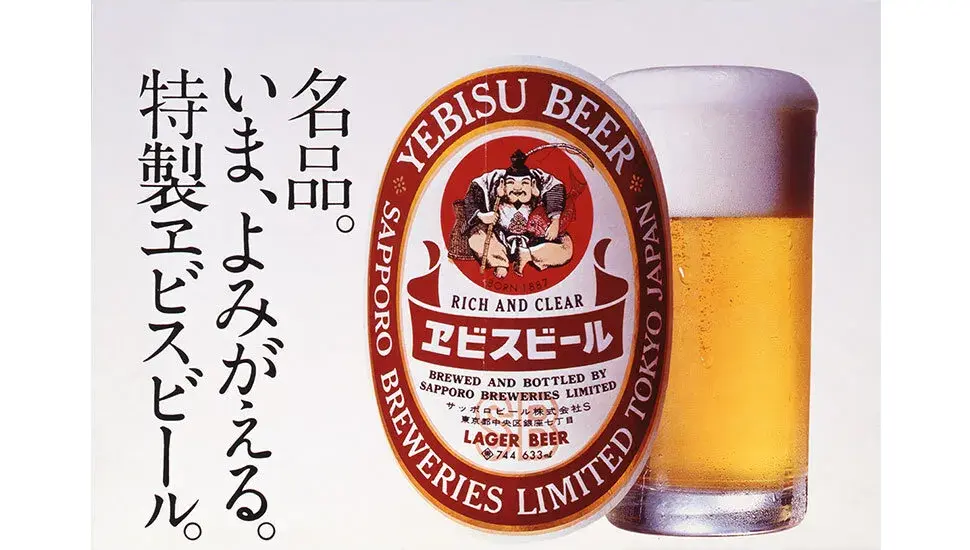
Poster from the revival of "Yebisu Beer"
As a promotional campaign, the words “Gold Yebisu” and “Silver Yebisu” were printed on the underside of bottle caps. Winners received an amulet featuring a gold or silver statue of the god Ebisu as a prize. This was not merely a giveaway; it was an attempt to convey the Yebisu brand’s worldview as an experience, serving to reinforce the narrative told through the product.
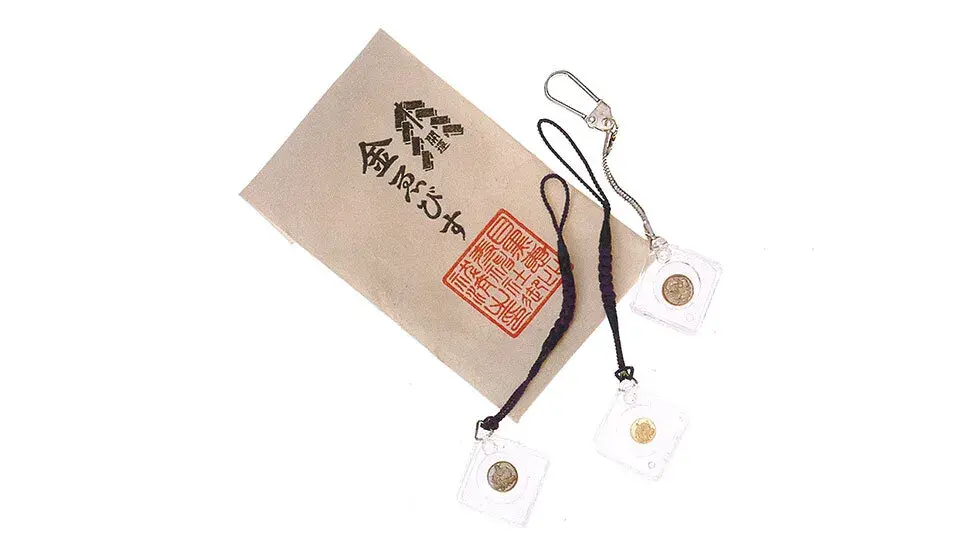
"Gold Yebisu" and "Silver Yebisu"
Sales of "Yebisu Beer" declined due to the impact of the 1973 oil crisis, but the brand quietly kept the flame alive, waiting for the next opportunity to take off. Eventually, its value was recognized once again, and today it has established itself as one of our company’s flagship brands.