Risk Management
Basic Approach to Risk Management
The Sapporo Group defines risks as uncertainties that may affect organizational operations, and we are working to prevent the occurrence of various management risks surrounding the Group. At the same time, when risks that may have a significant impact on corporate activities materialize, we promptly implement appropriate countermeasures to minimize losses while striving to ensure the continuous maintenance and development of our business and maintain the trust of society.
Furthermore, we appropriately manage and address risks, taking into consideration both threats and opportunities that could have a significant impact on corporate activities.
Risk Management Structure
The Sapporo Group has established and operates an Enterprise Risk Management (ERM) framework tailored to the Group’s business characteristics, with reference to the principles of ISO 31000, the international standard for risk management, to enhance the effectiveness of its risk management.
To realize the Group’s Medium- to Long-Term Growth Strategy, the Group identifies risks across its operations and determines material risks that could impede the execution of its strategies or the achievement of its management objectives. It assesses these risks based on their potential impact and likelihood of occurrence, formulates response plans, and implements and monitors appropriate measures to manage the risks effectively.
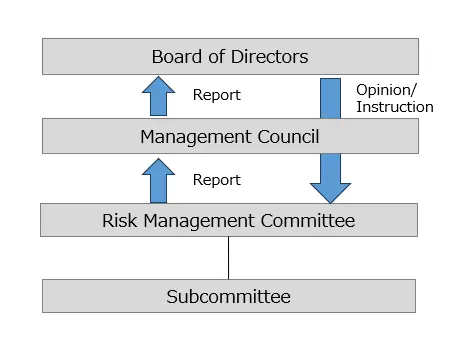
Sapporo Breweries has established the Risk Management Committee, chaired by the director in charge of risk management and composed of relevant officers and other members, as an advisory body to the Executive Council. The committee centrally manages material risks that could significantly affect the Group’s business activities. It oversees overall risk management activities, including the formulation of the Group’s risk management policy, the collection of risk information, risk mitigation initiatives, and the provision of necessary guidance and support to Group companies. In addition, the committee’s subcommittees work in cooperation with the departments responsible for risk management at major Group companies to promote initiatives addressing material risks facing the Group and individual Group companies and to monitor their progress. These initiatives and the Group’s material risks are reviewed by the Company’s Executive Council and reported to the Board of Directors. Based on these reports, the Board oversees the effectiveness of the Group’s risk management.
Furthermore, the Risk Management Committee manages sustainability-related risks in cooperation with the Global Sustainability Committee.
Risk Management Structure
Material Risks of the Sapporo Group
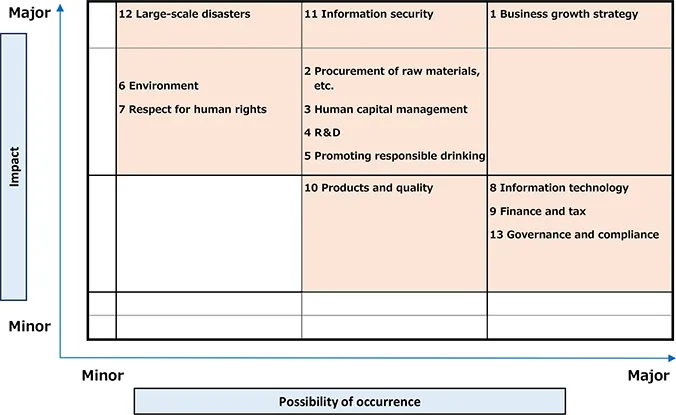
Among matters relating to the status of business operations and management, the major risks that management recognizes as having the potential to significantly affect investors’ decisions are as described below. For each risk, taking into account external environmental factors and other relevant circumstances, the Sapporo Group comprehensively evaluates risks that may have a significant impact on the Group from both quantitative and qualitative perspectives, based on internally defined indicators. The impact and likelihood of occurrence of each risk are assessed on a three-level scale of “high,” “medium,” and “low,” and risk items rated “medium” or higher for both impact and likelihood of occurrence are designated as material risks. The Group also classifies and manages major risks into business strategy risks and operational risks. However, the risks described below do not encompass all risks, and the Group may be affected in the future by risks other than those listed.
Information concerning the material risks of the Sapporo Group represents the judgments of the Sapporo Group as of the end of fiscal 2025.
Heat Map of Material Risks for the Group
<Business Strategy Risks>
| Item No. | Items | Anticipated risks | Impact when risks materialize | Major initiatives | YOY trend | Impact | Possibility |
|---|---|---|---|---|---|---|---|
| 1 | Business growth strategy |
|
|
[Company-wide]
|
↗ | Major | Major |
|
[Domestic] <Alcoholic Beverages>
<Food & Beverages>
<Foodservice>
|
[Domestic] <Alcoholic Beverages>
<Food & Beverages>
<Foodservice>
|
[Domestic]
|
|||||
|
[Overseas] <Alcoholic Beverages>
<Beverages>
|
[Overseas] <Alcoholic Beverages>
<Beverages>
|
[Overseas] <Alcoholic Beverages>
<Beverages>
|
|||||
| 2 | Procurement of raw materials, etc. |
|
|
|
→ | Major | Medium |
| 3 | Human capital management |
|
|
To strengthen human resources and organizational structures—critical management foundations—, advancing the following three human resources strategies:
|
↗ | Major | Medium |
| 4 | R&D |
|
|
|
↗ | Major | Medium |
| 5 | Promoting responsible drinking |
|
|
|
↗ | Major | Medium |
| 6 | Environment |
|
|
|
→ | Major | Medium |
| 7 | Respect for human rights |
|
|
|
→ | Major | Medium |
| 8 | Information technology |
|
|
|
→ | Medium | Major |
| 9 | Finance and tax |
|
|
|
→ | Medium | Major |
<Operational Risks>
| Item No. | Items | Anticipated risks | Impact when risks materialize | Major initiatives | YOY trend | Impact | Possibility |
|---|---|---|---|---|---|---|---|
| 10 | Products and quality |
|
|
*1 GFSI (Global Food Safety Initiative) is an organization primarily aimed at reducing food safety risks throughout the global food supply chain. *2 HACCP (Hazard Analysis & Critical Control Point) is published by the Codex Alimentarius Commission, a joint body of the Food and Agriculture Organization (FAO) and the World Health Organization (WHO). |
→ | Medium | Medium |
| 11 | Information security |
|
|
|
↗ | Major | Medium |
| 12 | Large-scale disasters |
|
|
|
→ | Major | Medium |
| 13 | Governance and compliance |
|
|
|
→ | Medium | Major |
(Note) We recognize that business strategy risks are not isolated risks, but rather interrelated risks.
Risk Management Structure for Overseas Subsidiaries
The "Sapporo Group Code of Conduct," the "Sapporo Group Standards of Conduct" and other regulations have been translated into local languages, and the Group works to ensure that they are fully disseminated at its overseas subsidiaries.
In addition, based on the Sapporo Group Risk Management Regulations, the Group has established a structure to enable prompt and appropriate responses in the event of an emergency or when facts are identified that may lead to an emergency.
Handling of Quality Risks
As part of its mission as a food company, the Sapporo Group places the highest priority on providing safe products to customers. The Group is strengthening its response to quality risks by, for example, providing awareness-raising programs and training sessions on risk management and risk communication to relevant departments and sections of Group companies.
(1) If the quality assurance department of a Group company receives a notification or consultation from a customer, employee, or other party regarding a food safety or quality assurance issue, except for minor issues, the department discusses corrective measures within the company’s crisis management organization, such as a risk management committee, and, after investigating the facts, reports the results to the Group Quality Assurance Department and to the secretariat of Sapporo Breweries’ Risk Management Committee, hereinafter referred to as the “RM Committee.”
(2) For quality assurance issues related to food safety, it is extremely important to respond promptly and appropriately at an early stage and to quickly share information across the Group. Therefore, if there is a suspicion of a serious incident, the quality assurance department of the relevant Group company, in cooperation with its own risk department, promptly reports the matter directly to the Group Quality Assurance Department and the RM Committee secretariat, without going through the company’s crisis management organization.
In such cases, the RM Committee secretariat, upon receiving the report, promptly reports the matter to the RM Committee chairperson, the acting chairperson, full-time Audit and Supervisory Committee members, and other committee members. The Group Quality Assurance Department monitors the status of activities at Group companies and provides support to help ensure that the value of each brand is not damaged.
Handling of Information Leakage Risks
In accordance with the Sapporo Group Code of Corporate Conduct, the Sapporo Group will implement appropriate security management measures for its trade secrets, which are assets of the Group.
Trade Secret Management Promotion Structure
To oversee and promote trade secret management activities across the Sapporo Group, the Group will establish the Information Protection Committee. The Group will also establish a Promotion Secretariat at each operating company in order to promote cross-departmental trade secret management.
Handling of Accidents and Violations
If an accident or violation related to trade secret management occurs, the Sapporo Group will convene Sapporo Breweries’ Risk Management Committee and respond appropriately, giving priority to customer protection and social responsibility.
Trade Secret Management
The Sapporo Group positions trade secret management as one aspect of business management, and identifies and properly manages its trade secrets. The Group also carries out employee education and management activities, such as responding to information security incidents or violations, in order to embed information security management for trade secrets throughout the organization.
Physical Security Management
The Group has established necessary management requirements, such as crime prevention and disaster prevention measures, as well as access control and monitoring, for its buildings, offices, and other facilities, in order to ensure their security and safety.
Information System Security Management
To reliably protect and effectively utilize digitized trade secrets, the Group has established information system security management requirements, including access restrictions and encryption for electronic data and files, the collection and monitoring of access logs, and countermeasures against malware, in order to ensure the security of its information systems.
Education
The Sapporo Group continues to provide education to ensure awareness of its internal rules and proper understanding of how to handle and manage trade secrets.
Continuous Improvement
As part of its ongoing business management activities, the Group verifies that trade secret management is being properly implemented and that necessary improvements are being made.
Countermeasures for Large-scale Disasters
The Sapporo Group has established the Group Severe Disaster Response Regulations, which specify the basic policies to be followed and provide an overview of disaster countermeasures. The Group is also continuously working to formulate and enhance its business continuity plans (BCPs) in preparation for the occurrence of severe disasters.
- Group Disaster Response Headquarters: The following matters are addressed as part of the initial response to a disaster.
① Confirm the safety of Group employees and assess the status of damage and other impacts.
② Assess the damage status of Group sites and buildings.
③ Share the information gathered in ① and ② within the Group. Group companies will determine whether or not to activate their BCPs, and the Company will disclose relevant information externally as needed. - Risk Management Committee: After assessing the damage status, the committee determines whether to activate the Group BCP and provides support when Group companies activate their own BCPs.
- Severe disasters: Earthquakes with a seismic intensity of 6-lower or higher on the Japanese seismic intensity scale occurring in Japan and accompanying tsunamis, or disasters designated by the Director of the Group Disaster Response Headquarters.
The BCPs are reviewed and revised as necessary, based on actions taken in response to disasters and subsequent verification results.
1. Activities within the Group
① Maintenance of disaster prevention stockpiles
We maintain disaster prevention stockpiles necessary for daily life during disasters, such as emergency food, water, and portable toilets, at all Group sites, and promote initiatives in line with the policies of local governments and the business operations of each Group company in the event of a disaster.
② Confirming and sharing information on the safety of Group employees and the damage status of their family members and homes
We promptly share this information using the Group’s standard emergency contact and safety confirmation system, “Emergency Call,” provided by Infocom Corporation.
③ Assessing and sharing information on damage to buildings and facilities at Group sites
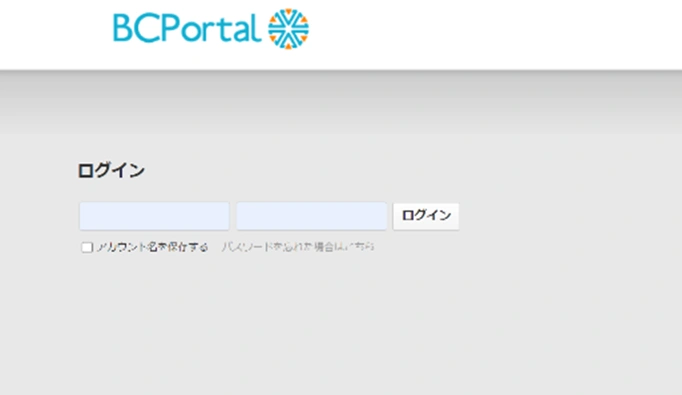
We use the Group’s standard building status reporting system, “BCPortal,” provided by Infocom Corporation, to consolidate and share information on damage across the entire Group by having each site enter information on damage to its buildings and facilities online.
In normal times, the Group regularly conducts input training for both systems so that it can respond swiftly and effectively in the event of a severe disaster. The Group also continues to review its operations.
2. Activities in Local Communities
The Sapporo Group is promoting initiatives to contribute to society and local communities, such as concluding agreements with local governments for the supply of goods and other support in the event of a disaster.
In addition, Group companies are continuously working on the formulation of BCPs, taking into account the characteristics of their respective businesses.
-
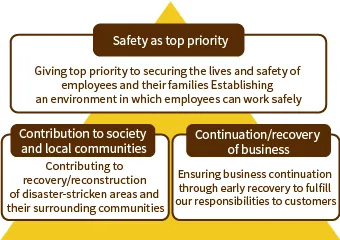
The three basic policies in the event of a severe disaster (from the Group Severe Disaster Response Rules)
-
Group standard safety confirmation system ("Emergency Call")
Building status reporting system at sites ("BCPortal")
Handling of Social Networking Services (SNS)
The Sapporo Group recognizes that if an employee posts an inappropriate comment on SNS or other online platforms, or if information disclosed by the Company or its responses to customers are inappropriate, such information or responses may rapidly spread online, potentially resulting in a significant loss of trust from stakeholders. Therefore, the Group raises awareness among Group employees regarding precautions for personal use of SNS and has established a structure to enable appropriate responses, including monitoring online information.
- Awareness-Raising for Group Employees
The Group works to ensure that employees thoroughly observe the following precautions when using SNS:
(1) Handle only publicly available information.
(2) Take personal responsibility for your comments and posts.
(3) Make transparent comments, and do not make comments that could be perceived as slanderous toward other companies or individuals.
(4) Respect your own privacy and the privacy of others.
(5) Do not use SNS for personal purposes during working hours.
- SNS Monitoring Structure
The Sapporo Group has established a structure to monitor SNS and monitors posts containing information related to the Group.
The Group also outsources monitoring to an external service provider during weekday nights and on holidays. In the event that information related to the Group spreads widely or causes online controversy outside working hours, the Group has established a structure to promptly share information among relevant departments and personnel and to respond appropriately.