Basic Policy and Structure
Basic Policy and Structure on Corporate Governance
The Sapporo Group has enacted the Basic Policy on Corporate Governance for the purpose of specifying its thinking and operational policy regarding corporate governance with the goal of attaining sustained growth and enhanced corporate value over the medium to long term, and in light of the purport and spirit of the Corporate Governance Code set forth in the Listing Rules of the Tokyo Stock Exchange.
As part of the policy, the Group's basic philosophy is to regard strengthening and enhancing corporate governance as one of its top management priorities. The Group is working to clarify supervisory, business execution, and auditing functions throughout the Group under the business holding company framework. The Group is also working to strengthen management supervisory functions to increase management transparency and achieve management goals.
Sapporo Group Corporate Governance Structure
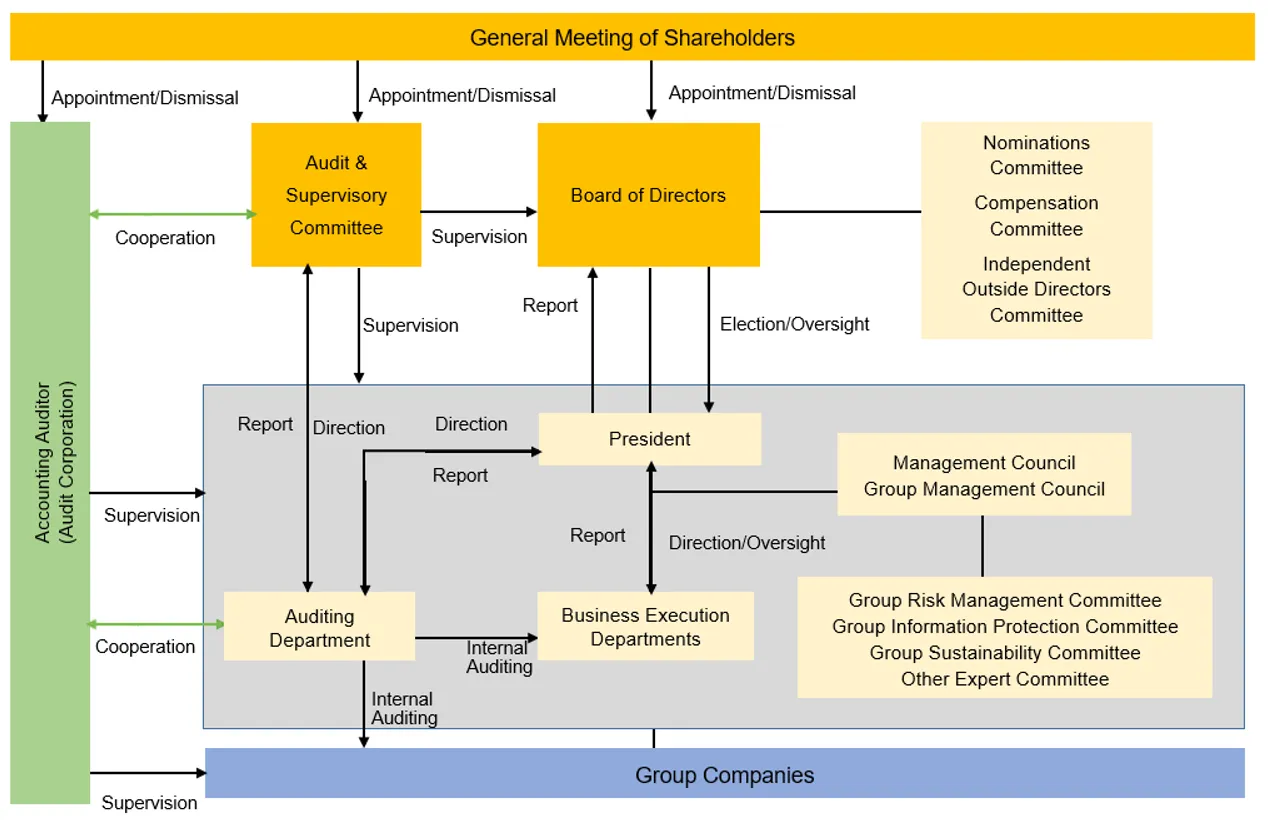
Board of Directors
The Board of Directors performs a supervisory role with regard to Group management. It makes decisions on statutory matters and important matters related to business execution as stipulated by the Board's regulations. The Board of Directors also elects and supervises the business execution of the representative director, president, Group operating officers.
【About Independent Outside Directors】
Seven of the eleven members of the company's Board of Directors are independent outside directors. All of them have submitted notification to the Tokyo Stock Exchange and the Sapporo Securities Exchange of their independent director status, as stipulated by the exchange regulations. The independent outside directors are expected to objectively advise and supervise the management team from a neutral standpoint. At the 14 meetings of the Board of Directors held in 2025, the independent outside directors gave advice and suggestions regarding various issues that were discussed from an objective viewpoint which was independent from that of the management.
Nominating and Compensation Committees
Sapporo Holdings has established a Nominating Committee and a Compensation Committee with the goals of increasing transparency with respect to the nomination and remuneration of directors, and of preserving a sound management structure.
The Nominating Committee is comprised of a total of seven members: independent outside directors (excluding directors who are members of the Audit & Supervisory Committee), directors who are members of the Audit & Supervisory Committee, and the president and representative director (or the chair of the Board if the president is selected from among the Group executive officers). The chair of the Committee is selected from independent outside directors (excluding directors who are members of the Audit & Supervisory Committee).
The Compensation Committee is comprised of a total of six members: independent outside directors (excluding directors who are members of the Audit & Supervisory Committee), directors who are members of the Audit & Supervisory Committee, and the president and representative director (or the chair of the Board if the president is selected from among the Group executive officers). The chair of the Committee is selected from independent outside directors (excluding directors who are members of the Audit & Supervisory Committee).
In fiscal year 2025, the Nominating Committee was held 14 times and the Compensation Committee was held eight times.
Group Operating Officers
The president controls business execution across the entire Group based on the resolutions of the Board of Directors. The Group operating officers, under the direct authority of the president, control business execution in the main business segments.
Audit and Supervisory Committee
Sapporo Holdings has adopted the Company with an Audit & Supervisory Committee System, which has the function of auditing and supervising the performance of duties by directors, to further enhance corporate governance by increasing management transparency and efficiency, and to further improve corporate value through strengthening the management oversight function to achieve management targets.
【About Independent Outside Directors】
Sapporo Holdings' Audit & Supervisory Committee is comprised of three members (two independent outside directors who are Audit & Supervisory Committee members and one company director who is a full-time Audit & Supervisory Committee member). Each of the two independent outside directors who are Audit & Supervisory Committee members is an independent director as stipulated under the regulations of the Tokyo Stock Exchange and the Sapporo Securities Exchange, and is expected to audit the performance of duties by directors from an objective and neutral standpoint.
At the 14 meetings of the Board of Directors held in 2025, the independent outside directors, who are also Audit Committee members, made appropriate recommendations and advice from the perspective of the legality, appropriateness, and validity of deliberations and decision-making. At the 20 meetings of the Audit Committee, they actively exchanged opinions with other Audit Committee members and made comments as necessary for deliberation of proposals.
Record of the Board of Directors and Committees Meetings Held in 2025
| Name | Position and responsibility in the Company | Board of Directors | Audit and Supervisory Committee | Nominating Committee | Compensation Committee | |||||||||
|---|---|---|---|---|---|---|---|---|---|---|---|---|---|---|
| Subject | Attendance | Attendance rate | Subject | Attendance | Attendance rate | Subject | Attendance | Attendance rate | Subject | Attendance | Attendance rate | |||
| Hiroshi Tokimatsu | President and Representative Director | Internal | 〇 | 11/11 | 100% | - | - | - | 〇 | 11/11 | 100% | 〇 | 7/7 | 100% |
| Masaki Oga(Note 1) | President and Representative Director | Internal | 〇 | 3/3 | 100% | - | - | - | 〇 | 3/3 | 100% | 〇 | 1/1 | 100% |
| Yoshitada Matsuide | Senior Managing Director | Internal | 〇 | 14/14 | 100% | - | - | - | - | - | - | - | - | - |
| Rieko Matsukaze | Senior Managing Director | Internal | 〇 | 14/14 | 100% | - | - | - | - | - | - | - | - | - |
| Toru Miyaishi | Director Chair of the Audit and Supervisory Committee Full-time Audit and Supervisory Committee Member |
Internal | 〇 | 14/14 | 100% | 〇 | 20/20 | 100% | 〇 | 14/14 | 100% | 〇 | 8/8 | 100% |
| Tetsuya Shoji | Director | Outside | 〇 | 14/14 | 100% | - | - | - | 〇 | 14/14 | 100% | 〇 | 7/7 | 100% |
| Toshihiro Uchiyama | Director | Outside | 〇 | 14/14 | 100% | - | - | - | 〇 | 11/11 | 100% | 〇 | 8/8 | 100% |
| Makio Tanehashi | Director | Outside | 〇 | 14/14 | 100% | - | - | - | 〇 | 14/14 | 100% | 〇 | 7/7 | 100% |
| Kotaro Okamura | Director | Outside | 〇 | 14/14 | 100% | - | - | - | - | 11/11 | - | 〇 | 8/8 | 100% |
| Ryotaro Fujii | Director | Outside | 〇 | 10/10 | 100% | - | - | - | 〇 | 14/14 | 100% | - | - | - |
| Kotaro Yamamoto | Director Audit and Supervisory Committee Member |
Outside | 〇 | 13/14 | 93% | 〇 | 18/20 | 90% | 〇 | 13/14 | 93% | 〇 | 7/8 | 88% |
| Naoko Tauchi | Director Audit and Supervisory Committee Member |
Outside | 〇 | 14/14 | 100% | 〇 | 19/20 | 95% | 〇 | 14/14 | 100% | 〇 | 8/8 | 100% |
| Total | 14 times | 20 times | 14 times | 8 times | ||||||||||
You can scroll to the right to view the entire table.
- (Note) 1 Mr. Masaki Oga, President and Representative Director, retired upon the expiration of his term at the Ordinary General Meeting of Shareholders held on March 28, 2025. Therefore, his position and attendance status prior to retirement are listed.
- The total number of meetings in the table differs due to differences in the timing of appointment and changes in the committee structure.
Standards and Policies Regarding the Independence of Outside Directors
Sapporo Holdings' Nominating Committee requires that candidates for outside director meet the company's Standards for Independence for Outside Directors. They are also required to have a strong background, track record, and insight into corporate management or certain specialist fields that will enable them to offer accurate proposals and advice on the company's management issues. For the company's Standards for Independence for Outside Directors, please refer to Appendix 1 of the "Basic Policy on Corporate Governance".
Compensation for Directors
The amount of individual remuneration for each director (excluding directors who are members of the Audit Committee) is determined by the Compensation Committee based on a resolution of the Board of Directors.
The amount of remuneration for each director who is a member of the Audit Committee is determined within the maximum amount of remuneration resolved at the General Meeting of Shareholders and in accordance with the criteria determined by the Audit Committee.
At the Board of Directors meeting held on February 14, 2024, a policy on the determination of the details of compensation, etc., for each director (hereinafter referred to as the "Policy for Determining the Details of Compensation, etc. for Directors") was resolved. A summary of the policy on the determination of details of compensation is as follows.
1. Basic Policy
- The remuneration of the Company's Directors (excluding Directors who are members of the Audit and Supervisory Board, and the same shall apply hereinafter) shall be a combination of cash and stock-based remuneration, and shall be linked to the Company's business performance and medium- to long-term corporate value, with the aim of contributing to the sustainable growth of the Company. The Company's basic policy is to set the remuneration of individual Directors at an appropriate level in consideration of their respective responsibilities.
- Remuneration for executive directors shall consist of cash remuneration and remuneration in the form of the Company's stock.
- Monetary remuneration shall consist of (1) basic remuneration (fixed remuneration) and (2) performance-linked remuneration, within the limit of the maximum amount of remuneration resolved at the General Meeting of Shareholders.
- The company's stock-based remuneration shall be composed of performance-linked stock-based remuneration as a base.
- Outside directors shall be paid only the basic remuneration.
2. Basic Remuneration
The basic remuneration for the Company's Directors shall be a fixed monthly amount in cash. The amount of the basic remuneration shall be determined by taking into consideration the position, the world standard, and the Company's business performance, as well as other factors, in a comprehensive manner.
3. Performance-linked Remuneration
Performance-based bonuses are monetary incentives based on the previous year's job performance. The amount is calculated based on the achievement level in relation to the target values of ROE and EBITDA for each fiscal year, and it is paid out in a lump sum every April, varying by position.
4. Share-based Compensation
The Company's stock-based compensation shall be performance-linked stock compensation. The stock-based compensation is in the form of performance-based stock options. In its calculation, points are awarded based on the achievement level of evaluation indicators that lead to the improvement of the medium to long-term corporate value (medium to long-term financial indicators, ESG indicators, employee engagement), as well as the evaluation of each director, and stocks of our company are granted according to the number of points awarded to each director after retirement. Details shall be stipulated in the Directors' Stock Benefit Regulations to be separately stipulated.
5. Percentage Ratio
The approximate ratio of basic remuneration, performance-linked remuneration, and treasury stock remuneration shall be 5:3:2 when the degree of achievement of performance targets is the highest.
6. Determination of Remuneration
Decisions on the details of individual remuneration, etc. of Directors shall be delegated to the Compensation Committee.
- * Details about the Compensation Committee are as described above.
The amount of remuneration for fiscal year 2025 is as follows.
| Classification | Total compensation amount (in millions of yen) |
Total amount of compensation by type (in million yen) | Number of targeted directors (persons) | ||
|---|---|---|---|---|---|
| Basic salary | Performance-based bonuses | Performance-based stock compensation |
|||
| Directors (excluding members of the Audit Committee) (Outside Directors) |
299 (66) |
196 (66) |
79 (-) |
24 (-) |
9 (5) |
| Directors (Audit Committee members) (Outside Directors) |
58 (29) |
58 (29) |
- (-) |
- (-) |
3 (2) |
| Total (Outside Directors) |
357 (95) |
253 (95) |
79 (-) |
24 (-) |
12 (7) |
(Note)
- The maximum amount of remuneration for Directors (excluding Directors who are members of the Audit Committee) was resolved at the 100th Ordinary General Meeting of Shareholders held on March 28, 2024, to be within 500 million yen per year (within 100 million yen per year for Outside Directors, excluding employee salaries of Directors who are also employees).
The maximum amount of remuneration for Directors who are members of the Audit Committee was resolved at the 96th Ordinary General Meeting of Shareholders held on March 27, 2020, to be within 84 million yen per year. - For Directors (excluding Outside Directors), a performance-linked stock-based remuneration system called the "Stock Benefit Trust (BBT)" has been introduced, and 446 million yen (for three fiscal years) has been contributed in accordance with the Directors' Stock Benefit Regulations stipulated under this system. This system was resolved at the 92nd Ordinary General Meeting of Shareholders held on March 30, 2016, separately from the Directors' remuneration described above.
Variable remuneration system, evaluation indicators, and results, etc. for the current fiscal year
| Classification | Indicators(Note 1) | Results, etc.(Note 2) | |
|---|---|---|---|
| Performance-linked remuneration | ROE (vs. plan) | Achievement level of actual value against target value for the fiscal year | Actual: 9.4% / Plan: 5.5% |
| EBITDA (vs. plan) | Achievement level of actual value against target value for the fiscal year | Actual: 53.9 billion yen / Plan: 46.7 billion yen | |
| Performance-linked stock-based remuneration | Medium- to long-term financial indicators | "ROE" Annual evaluation criteria are set against the target value of the medium-term management plan (8%) and evaluated |
2025 actual: 9.4% |
| ESG indicators | 1. FTSE Russell ESG Score(Note 3) 2. MSCI ESG Rating(Note 3) 3. Greenhouse gas emissions reduction (Scope 1, 2) Annual evaluation criteria for scores and ratings of each indicator are set |
2025 actual 1. 3.4 2. AA 3. To be evaluated based on preliminary figures in March 2026 |
|
| Employee engagement | "Work engagement"(Note 4) Annual evaluation criteria are set based on deviation values from external organization surveys |
2025 actual: A | |
| Individual evaluation | Performance demonstrated by each officer | Determined by the Compensation Committee based on individual evaluation indicators | |
(Note)
- The Company selected these indicators with the aim of contributing to the sustainable growth of the Company by making performance-linked remuneration contingent on the results of job performance for each fiscal year, and by linking performance-linked stock-based remuneration to the medium- to long-term corporate value of the Company.
- Plans and actuals before classification of the real estate business as discontinued operations.
- Scores and ratings by international external evaluation organizations that collect, analyze, and evaluate ESG-related information of companies.
- A state in which employees have positive feelings toward their work and are fulfilled.
Internal Audits
Under instructions from the president and representative director or the Audit & Supervisory Committee, the Group Audit Department, an internal auditing organization independent of the executive chain of command, audits overall operations of the Company and its subsidiaries with regard to the status of compliance with laws and regulations, the articles of incorporation, and internal regulations. The audit reports are circulated to the president and representative director, Audit & Supervisory Committee, and relevant parties.
Upgrading the Internal Control System
To ensure thorough implementation of the basic policies decided by the Board of Directors and carry out ongoing development and strengthening of systems across the entire Group, the Board of Directors takes responsibility for appointing directors with specific responsibilities and promoting specific measures. Moreover, the Guidelines on the Construction of Internal Control Systems at Sapporo Group have been enacted to set out specific matters in relation to internal control systems at the Group, and these guidelines are used to confirm the level of progress being made in individual measures and to promote collaboration.
For details about the status of our company's corporate governance, please refer to our annual securities report and the corporate governance report submitted to the Tokyo Stock Exchange and the Sapporo Securities Exchange.
Please see below for the status of our policy on dialogue with the capital market.
Please see below for details on the dialogue with investors and the cycle of feedback to management, etc.