Promoting Compliance
Basic Approach
- The Sapporo Group has established the “Sapporo Group Code of Conduct” and, based on the code, the "Sapporo Group Standards of Conduct" as a set of principles to encourage all directors, officers, and employees to act in accordance with sound ethical principles. The Group regularly evaluates and reviews the effectiveness of the Code and Standards in order to maintain and enhance its compliance initiatives. The Board of Directors supervises the implementation of the Code and Standards. The establishment of and revisions to the Code, excluding minor revisions, are subject to approval by the Board of Directors.
- With regard to risk management across the Sapporo Group, the Group has established a Risk Management Committee chaired by the director in charge of risk management. Under normal circumstances, the Committee reviews the Group-wide status of risk responses, while in the event of a risk-related incident, it has a structure in place that enables prompt decision-making.
- The Sapporo Group has established the “Sapporo Group Corporate Ethics Hotline” for the purpose of preventing misconduct and detecting it at an early stage. In addition, the Audit Department, an internal audit organization independent from business execution departments, conducts audits of Sapporo Breweries and other Group companies covering overall business operations, including the status of compliance with laws and regulations, the Articles of Incorporation, and internal rules.
Establishment of Organizations and Frameworks to Promote Compliance Awareness and Initiatives
Compliance promotion within the Sapporo Group is primarily led by the General Affairs Department of Sapporo Breweries. Each company within the Group has designated a department responsible for compliance promotion and is working to advance both Group-wide compliance initiatives and company-specific measures internally.
In addition, major Group companies appoint “Compliance Key Persons” at each business site, who play a leading role in promoting compliance initiatives in the workplace. For newly appointed Compliance Key Persons, including those assigned through regular personnel rotations, group-wide training sessions are conducted to enhance their knowledge and perspective as leaders in promoting compliance.
Basic Approach to Specific Initiatives
Dissemination of the Sapporo Group Code of Conduct and Standards of Conduct
- The “Sapporo Group Code of Conduct” and the "Sapporo Group Standards of Conduct," which apply to all directors, officers, and employees working within the Sapporo Group, are communicated internally by being posted on each company’s intranet and in the “Sapporo Minibook.”
- The Group promotes understanding of the Code and Standards through compliance training programs, including e-learning courses and workplace study sessions for all directors, officers, and employees across the Group.
Dissemination of the Sapporo Group Basic Policies, Group Regulations, and Company-Specific Policies
The Sapporo Group has established various basic policies, including the “Sapporo Group Management Philosophy and Basic Management Policy,” as well as a wide range of rules and regulations. These basic policies, rules and regulations are communicated to all directors, officers, and employees by being posted on the intranet and in the “Sapporo Minibook,” in the same manner as the "Sapporo Group Code of Conduct" and the "Sapporo Group Standards of Conduct".
In particular, key policies aimed at ensuring compliance with important laws and regulations—such as the “Basic Policy for Systems to Eliminate Anti-Social Forces,” the “Sapporo Group Regulations on the Prevention of Insider Trading,” and the “Sapporo Group Anti-Bribery and Anti-Corruption Policy”—are disseminated and embedded through compliance training programs, including e-learning and workplace study sessions conducted for all directors, officers, and employees.
Research and Monitoring of Laws and Regulations, and Internal Awareness
Each company within the Sapporo Group conducts research and monitoring of various laws and regulations related to corporate management and business operations. To ensure proper compliance, responsibilities for applicable laws and regulations are clearly assigned to each relevant department. The Group also utilizes systems that enable the timely acquisition of information on legal and regulatory changes.
Departments responsible for specific laws and regulations appropriately communicate important regulatory information—particularly with regard to key laws—to relevant personnel within the organization through suitable channels.
Whistleblowing System
Sapporo Breweries established the “Sapporo Group Corporate Ethics Hotline Regulations” in 2003 with the aim of contributing to the sound development of the Group. This includes preventing misconduct such as fraud, bribery, money laundering, and insider trading within the Group, enabling early detection of such misconduct, and fostering a high level of ethical awareness among employees. These regulations are reviewed periodically in light of legal revisions and other developments.
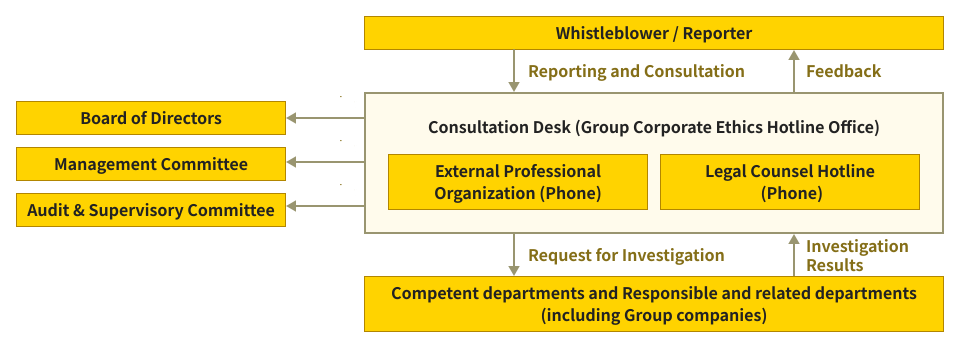
The Regulations require individuals who become aware of misconduct to report it. They also stipulate measures to protect whistleblowers from disadvantageous treatment, including that information that could identify the whistleblower, such as their name, must not be disclosed without their consent and that their privacy must be protected. Furthermore, if any disadvantageous treatment or retaliatory actions against a whistleblower are confirmed, the Company or the responsible party will be immediately ordered to cease such actions. The Regulations also define procedures for conducting fact-finding investigations and measures to be taken against those who violate the Regulations.
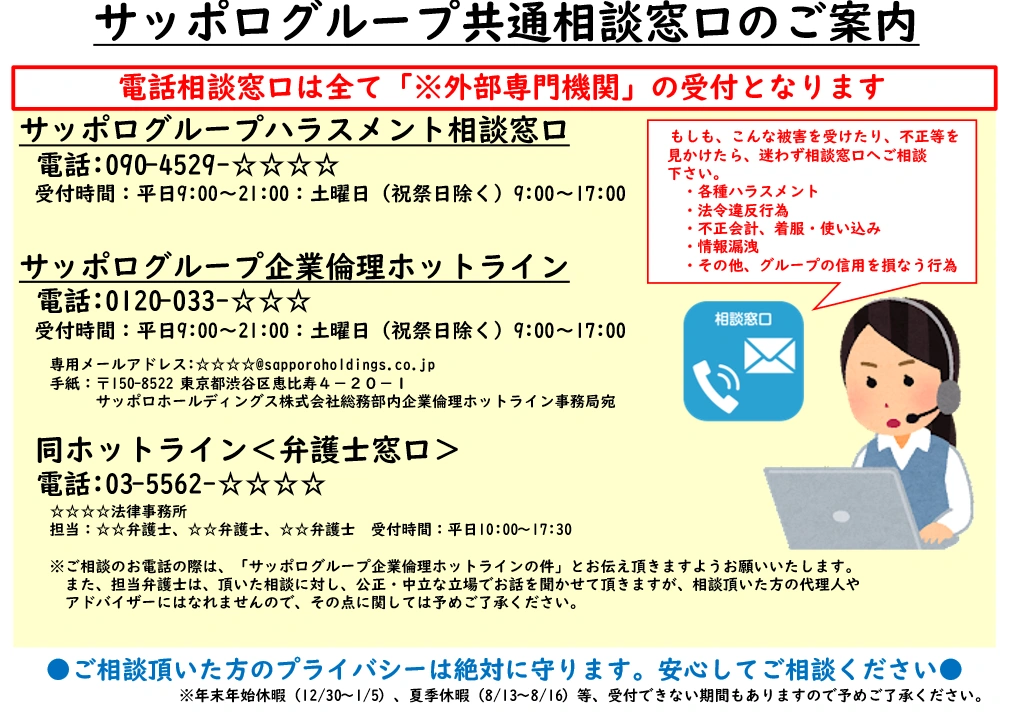
Based on these Regulations, the “Sapporo Group Corporate Ethics Hotline” has been established, with the General Affairs Department of Sapporo Breweries serving as the secretariat. Multiple reporting channels are provided, including external specialized organizations and legal counsel, and anonymous consultations and reports are permitted. The Group works to ensure the proper operation and awareness of the system. Eligible users include all individuals working within the Sapporo Group, including employees, part-time staff, temporary workers, and others. Dedicated consultation channels are also provided on the Sapporo Breweries website for business partners and contractors (including freelancers).
Reports involving suspected serious misconduct are promptly reported to the secretariat of the Risk Management Committee. Under the direction of the Committee Chair or Acting Chair, the secretariat may conduct an investigation through the Risk Management Committee when necessary. If misconduct is confirmed or deemed likely to occur, the Committee will order the relevant company or individual to cease such conduct.
In addition, consultations regarding harassment are accepted through the separately established “Sapporo Group Harassment Consultation Desk” as well as “Corporate Ethics Consultation Desks” set up at major Group companies.
Sapporo Group Anti-Bribery and Anti-Corruption Policy
Based on the "Sapporo Group Code of Conduct," the Sapporo Group has established the “Sapporo Group Anti-Bribery and Anti-Corruption Policy.” Under this policy, the Group complies not only with Japan’s Penal Code and the Unfair Competition Prevention Act, but also with applicable anti-bribery and anti-corruption laws and regulations in the countries and regions where it condCoucts business, including the U.S. Foreign Corrupt Practices Act (FCPA) and the U.K. Bribery Act. The policy prohibits bribery and other corrupt practices, including the giving and receiving of bribes, money laundering, insider trading, and other forms of corruption.
The Sapporo Group ensures that this policy is fully communicated and implemented among all directors, officers, and employees through compliance training programs, including e-learning. The Board of Directors supervises the implementation of this policy and works to prevent bribery and corruption throughout the Group.
Examples of violations of the Sapporo Group Basic Policy on Anti-Corruption in fiscal year 2025
| Employees who have been disciplined or dismissed | None |
|---|---|
| Corruption-related fines, surcharges, and settlements | None |
Sales Activities Based on Internal and External Guidelines
Alcoholic beverages are products with intoxicating properties and are subject to regulations such as licensing requirements under the Liquor Tax Act. Accordingly, Sapporo Breweries not only ensures compliance with applicable laws and regulations but also conducts its business with due consideration for its social impact and responsibilities. Specifically, the Company complies with the Act against Unjustifiable Premiums and Misleading Representations,*1 the Fair Competition Codes established by the Japan Brewers Association,*2 the industry’s voluntary standards on advertising, promotion, and labeling of alcoholic beverages, as well as its own internal rules such as the “Premiums Policy” and the “Sapporo Breweries Advertising Regulations.” Through these efforts, the Company promotes fair sales promotion and responsible advertising practices.
In addition, Sapporo Breweries provides employee education on these matters through training programs and compliance study sessions for sales personnel.
- Act against Unjustifiable Premiums and Misleading Representations
- Fair Competition Code concerning the Labeling of Beer and Fair Competition Code concerning Restrictions on Premiums in the Beer Manufacturing Industry
At Pokka Sapporo Food & Beverage Ltd., monthly workplace study sessions using case studies are conducted for all employees—not only sales personnel—to deepen their understanding of the "Sapporo Group Code of Conduct" and the "Sapporo Group Standards of Conduct, including how they relate to various laws, regulations, and guidelines, and to foster a strong sense of ethics.
Furthermore, as a manufacturer of beverages and food products, Pokka Sapporo recognizes the importance of food labeling. With the aim of enhancing the capabilities of departments involved in product development, it has been encouraging primarily product development personnel to take the “Intermediate Food Labeling Certification Examination” administered by the Food Labeling Certification Association since fiscal 2013.
Group-wide Initiatives
The Sapporo Group implements the following initiatives on a Group-wide basis, with each Group company taking the lead in carrying them out.
Preparation and Dissemination of the “Sapporo Minibook”
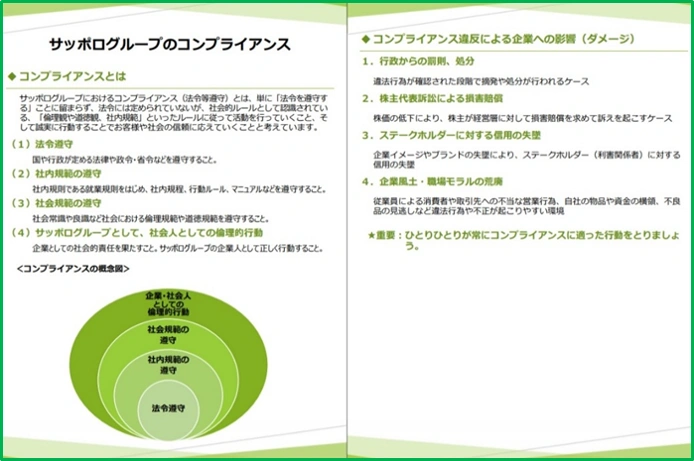
The Sapporo Group prepares the “Sapporo Minibook,” which contains compliance-related matters common to the entire Group, and makes it available on the intranet to ensure that necessary information for promoting compliance is widely communicated.
Main Items Covered:
The Sapporo Group Management Philosophy; the Code of Conduct and the Standards of Conduct; major Group regulations; consultation and reporting channels such as the Corporate Ethics Hotline; and initiatives related to harassment prevention, protection of personal information, and the elimination of anti-social forces.
Implementation of Group-wide Compliance E-learning Training
Since 2007, the Sapporo Group has conducted annual compliance e-learning training for all directors, officers and employees, with the objective of ensuring that each individual understands the "Sapporo Group Code of Conduct," the "Sapporo Group standards of Conduct," key Group policies and regulations, and important laws and regulations, and acts based on sound ethical judgment. Through these efforts, the Group aims to reduce compliance risks in day-to-day business activities. The Group is also committed to achieving a 100% participation rate; in 2025, the participation rate reached approximately 99%.
The Group continues to implement ongoing initiatives to enhance compliance awareness and ensure the retention of knowledge among participants.
<Main Topics Covered in Compliance Training (2024 and 2025)>
Sustainability, anti-corruption, harassment prevention, prevention of communication failures, insider trading prevention, internal control, information protection, alcohol-related issues, and appropriate use of social media
Employee Compliance Awareness Survey
As part of the Group-wide “Employee Awareness Survey” conducted by the human resources function, the Sapporo Group includes questions related to compliance. The survey is used to assess the extent to which compliance awareness and conduct based on the "Sapporo Group Code of Conduct" and the "Sapporo Group Standards of Conduct" have been embedded among employees. The results are reported to the management of each Group company and are utilized to enhance compliance initiatives across the Group and within each company.
Internal Initiatives for Responsible Drinking
As a corporate group engaged in the alcoholic beverages business, the Sapporo Group recognizes its social responsibility to promote responsible drinking. In addition to conducting awareness-raising activities, the Group also implements initiatives to encourage responsible drinking among all directors, officers and employees.
All directors, officers and employees of the Sapporo Group are expected to practice responsible drinking themselves. Excessive drinking may increase the risk of compliance issues, such as harassment and information leakage, as well as causing inconvenience to others. Accordingly, the Group provides education on responsible drinking, including the following initiatives.
Initiatives to Eliminate Anti-Social Forces
The "Sapporo Group Code of Conduct" and the "Sapporo Group Standards of Conduct" established thereunder stipulate that all directors, officers, and employees must act with a firm resolve not to yield to anti-social forces. In light of the enactment and enforcement of ordinances for the elimination of organized crime groups in each prefecture, the Group is committed to completely severing any relationships with anti-social forces.
In addition, Sapporo Breweries revised in December 2011 its “Basic Policy for Systems to Eliminate Anti-Social Forces,” which forms part of its “Basic Policy for the Establishment of an Internal Control System,” taking into account the purpose of the Tokyo Metropolitan Ordinance for the Elimination of Organized Crime Groups, which came into effect in October 2011. The revised policy was adopted as a Sapporo Group policy and clearly states that the Group will sever all relationships with anti-social forces and organizations.
When entering into contracts, the Group confirms that the counterparty does not fall under the category of anti-social forces. If it is later found that the counterparty is an anti-social force, the contract may be terminated.