Sustainability Material Issues and Implementation Structure

Sustainability Material Issues

The Sapporo Group evaluates "the degree of impact of our business on society and the environment" and the degree of impact of society and the environment on our finances in terms of risks and opportunities designating nine Sustainability Material Issues that the Group considers particularly important and will focus on in its business activities. In response to changes in the social and business environment surrounding the Group, we periodically review these material issues, and some have been updated for 2025.
Among these, we have positioned "realization of a decarbonized society," "realization of a society in harmony with nature," "mutual prosperity with local communities," "promoting responsible drinking," and "active participation of diverse human resources" as issues of particular importance in our management.

Risks and Opportunities by Material Issues

Classification Most Important Issues Material Issues Impact of Our Business on Society and the Environment Social/Environmental Impact on Corporate Finances
Risk Opportunity Risk Opportunity
Harmony with the Environment 1. Realization of a decarbonized society Large Large Large Medium
2. Realization of a recycling-based society Large Medium Large Medium
3. Realization of a society in harmony with nature Large Medium Large Medium
Co-prosperity with Society 4. Mutual prosperity with local communities Medium Large Medium Large
5. Providing health value Small Large Small Large
6. Promoting Responsible Drinking Large Large Large Large
Success of Human Resources 7. Active participation of diverse human resources Small Medium Large Large
8. Building a sustainable supply chain Large Small Large Small
9. Promoting Safe Products and Facilities Large Medium Large Medium

Sustainability Material Issues Targets and Indicators

* Target setting company notation SH: Sapporo Holdings, SB: Sapporo Breweries, PS: POKKA SAPPORO Food & Beverage, SRE: SAPPORO REAL ESTATE, SLN: Sapporo Lion, SBL: Sleeman, SAS: Sapporo Stone Brewing, SVL: Sapporo Vietnam, YSM: Yasuma, FBS: Foremost Blue Seal, PK: Pokka, SSI: Shinsyu-ichi Miso

Classification Most Important Issues Material Issues Specific Initiatives Indicators Targets Setting Companies Target Year Targets SDGs
Harmony with the Environment Realization of a decarbonized society Reducing greenhouse gas emissions at company sites and supply chains
  • Greenhouse Gas Emission Reductions
  • Certified by Science Based Targets Initiative (SBTi)
Sapporo Group 2030
  • Scope 1,2 Reduce greenhouse gas emissions by 42% compared to 2022
SDG 7: Affordable and Clean Energy
SDG 13: Climate Action
SDG 17: Partnerships for the Goals

7.2
13.1
17.17

Sapporo Group
(SB, SBL, PS)
  • Scope 3 Reduce greenhouse gas emissions by 25% compared to 2022
  • FLAG Scope 1,3: Reduce greenhouse gas emissions by 31% compared to 2022
Realization of a recycling-based society
  • Realization of containers and packaging compatible with a recycling-oriented society
  • Reduction and recycling of plastic resources
  • Usage rate of recycled materials in PET bottle products
PS 2030
  • Sales of PET products in Japan: Recycled material usage rate 50%
SDG 12: Responsible Consumption and Production
SDG 14: Life Below Water

12.3
12.4
12.5
14.1

  • Reduction of plastic used in advertisement products
SB 2030
  • Single-use plastic advertising products derived from fossil fuels: abolished in principal in Japan
Reduction of waste and food loss
  • Implementation rate of food recycling etc.
SLN
  • Implementation rate of standards set by the Food Recycling Act (+1% per year)
  • 50% achieved by fiscal year 2023
  • Waste recycling rates at production sites
SB, PS
  • Waste recycling rate of 100% at production sites in Japan
Conservation of Water Resources
  • Water usage per unit of production
SVL 2030 At Long An Factory, which is located in a high-risk water area:
  • Reduce water usage per unit of production in 2030 by 10% compared to 2023 levels
  • Properly communicate with local communities about water risks, such as floods, and strive to minimize their impact
SDG 6: Clean Water and Sanitation

6.4

  • Water risk management
SB, SBL, SAS, SVL, PS, PK, YSM
  • Survey of water risks at all production bases, etc. once/within 3 years
  • Efficient use of water
Realization of a society in harmony with nature Mitigation Measures for Climate Change and Measures to Reduce Impacts on Nature
  • Nitrogen fertilizer input per unit of barley/malt, optimization of fertilization communication.
SB 2030
  • Achieve 100% implementation of communication efforts to track nitrogen fertilizer application per unit of barley/malt and optimize fertilization practices.
  • Achieve 100% implementation by 2030.
  • Sharing our FLAG Scope 1 and 3 targets and conducting on-site visits to collect information on the use of nitrogen-based chemical fertilizers and organic fertilizers
SDG 13: Climate Action
SDG 15: Life on Land

13.1
15.4

Crop cultivation that responds to climate change, Facility/community development that coexists with nature
  • Progress in developing ingredients to respond to climate change
SB 2030
  • Application for registration of domestic varieties of barley and hops with characteristics that can respond to climate change
Co-prosperity with Society Mutual prosperity with local communities
  • Improvement of regional value
  • Resolution of local issues using company resources
  • Progress of our "regional revitalization business"
SB
  • In order to create sustainable regions in cooperation with local governments, we will conduct matching between local food suppliers and companies at food business meetings
  • Satisfaction rate of local governments, suppliers, and buyers at business meetings is 75.0% or higher.
SDG 4: Quality Education
SDG 8: Decent Work and Economic Growth
SDG 11: Sustainable Cities and Communities
SDG 17: Partnerships for the Goals

4.7
8.9
11.3
11.7
17.17

  • Progress in building an environment for lemon production in Japan
PS ◆Long-term
  • Inherit the rich land and blessings of lemon cultivation in Japan for the future generations and the local community.
◆Short-term
  • Increase the minimum unit of farmland by at least 2,000m2 every year
  • Expand cultivated land in cooperation with partners, not only by ourselves
  • Taking over farmland without a successor, regenerating abandoned farmland, and other initiatives
  • Number of regional learning programs (food education, on-site classes, factory tours, etc.) related to the food and beverage business
PS 2030
  • Ten times as many as FY2021 (400 cases)
Providing health value Provision of health value through business
  • "Pokka Lemon" brand summary [Annual purchase rate (%)・Annual purchase quantity (number per buyer)]
PS 2030
  • Contribute to people's well-being by expanding the total demand for lemons by disseminating the health functions of lemons and proposing uses and occasions.
SDG 2: Zero Hunger
SDG 3: Good Health and Well-being
SDG 11: Sustainable Cities and Communities

2.1
3.4
11.3

  • Development status of products that contribute to customer health
PK 2030
  • Reduce added sugar to within 4.5% for products sold in Singapore and Malaysia (limited to POKKA products).
  • Status of acquisition of certifications for properties that contribute to the provision of health value
SRE
  • Acquisition of certification for owned properties that contribute to the provision of health value
Promoting Responsible Drinking
  • Awareness-raising of responsible drinking
  • Progress in the labeling of pure alcohol content
SB 2025
  • 100% display of pure alcohol content (g) per bottle on canned alcoholic beverages and lightly alcoholic beverage containers produced and sold in Japan
SDG 3: Good Health and Well-being

3.5

  • Percentage of employees participating in awareness-raising activities related to responsible drinking through e-learning, etc.
SB, SLN
  • Education through e-learning, etc. for all domestic employees (more than once a year) 100% participation
  • Strengthen initiatives for non-alcoholic, low-alcoholic, and reduced-alcohol products
SB 2026
  • To meet the diverse needs of customers, we aim to expand the range of options in non-alcoholic, low-alcohol, and reduced-alcohol products.
SLN
  • Satisfaction with responsible drinking seminars
SB 2027
  • By providing customers with information on responsible drinking and promoting awareness activities, we aim to prevent harmful alcohol consumption and contribute to society.
  • Achieve a satisfaction rating of 4 or higher (on a 5-point scale) in post-seminar surveys by 2027.
  • Number of incidents of accidental ingestion of alcohol at restaurants
SLN
  • 0 cases
  • Display rate of messages to prevent drinking under the age of 20 on restaurant menus and at the POP
SLN
  • 100%
Success of Human Resources Active participation of diverse human resources Promotion of Diversity, Equity & Inclusion (DE&I)
  • Development status of systems and environments that match diverse values and new work styles
SH, SB, PS, SRE, SLN 2026
  • Work engagement(*) 54 or higher
  • Index based on stress checks and employee awareness surveys
SDG 5: Gender Equality
SDG 8: Decent Work and Economic Growth

5.5
8.5

SBL
  • Percentage of employees who received DE&I training: 100%
  • Percentage of employment leaders who have attended conscious inclusion training: 100%
SVL
  • DE&I comprehension: 6.0 points(*)
  • Number of local employees in management: 2
  • Organizational Culture Survey 6.00 points(*)
  • Indicators from the "Organizational Culture Survey" by SVL (out of 7 points).
PK
  • engagement(*) 80%
  • Indicators based on "Employee Survey" conducted by PK (76% benchmark)
  • Progress status of promotion of women's empowerment
SH, SB, PS, SRE, SLN 2026
  • At least 12% female executives and at least 12% female managers
SH 2030
  • At least 30% female executives
SH, SB, PS, SRE, SLN
  • At least 20% female managers
Investing in human capital for growth and productivity
  • Progress in fostering a challenging culture for future value creation
SH, SB, PS, SRE, SLN 2026
  • Integrated survey "Challenges for future value creation"(*) 3.0 or higher
  • Sapporo Group's own survey index based on stress checks and employee awareness surveys <1.0 to 4.0 digitized>.
  • Progress status of human resource development through active investment (management human resources/global core human resources/DX/IT core human resources)
SH, SB, PS, SRE, SLN 2026
  • Sufficient personnel to provide successor candidates for management positions
  • 100 persons of global core human resources
  • 200 persons of DX/IT core human resources
  • Degree of improvement in productivity due to improved mental and physical health
SH, SB, PS, SRE, SLN 2026
  • Presenteeism loss rate(*) 33.4% or less
  • An index based on stress checks and employee awareness surveys, the average of SH and the four operating companies
Building a sustainable supply chain
  • Respect for Human Rights in the Supply Chain
  • Reduction of environmental impact in the supply chain
  • Stable procurement
  • Compliance rate with the Sustainable Procurement Guidelines
SB, SBL, SAS, SVL, PS, PK, YSM, FBS, SLN
  • Implementation of measures to promote and disseminate the Basic Procurement Policy and Sustainable Procurement Guidelines
SDG 10: Reduced Inequalities
SDG 15: Life on Land
SDG 17: Partnerships for the Goals

10.2
15.3
17.17

SB, PS
  • 100% compliance rate with the Sustainable Procurement Guidelines of major suppliers
  • Status of verification of supply chain construction that prevents deforestation
Sapporo Group
  • Establishment and implementation of a scheme (2) to verify that there is no deforestation in the procurement of high-risk items (1).

    (1) Beef, palm oil, soy, cocoa, wood, and wood fibers

    (2) Explanation of our company's policy to suppliers, verification of the existence and implementation of the policy through surveys, etc., and corrective actions as needed.

  • Progress of human rights DD process
SB, SBL, SAS, SVL, PS, PK, YSM, FBS, SLN
  • Establishment and implementation of a scheme(*) that can confirm respect for human rights in the supply chain (Priority implementation from major raw materials and high-risk raw materials)
  • (1) Compilation of a list of the supply chain for each raw material
    (2) Confirmation of daily activities through questionnaires, etc.
    (3) Investigation of the situation, etc. as necessary
    (4) Confirmation of corrective actions as necessary
SB, PS 2025
  • Confirmation that human rights are respected when procuring major raw materials and high-risk raw materials
Promoting Safe Products and Facilities Food safety
  • Operation and continuous improvement of the food safety assurance system
  • Number of serious food accidents
SB, SBL, SAS, SVL, PS, PK, FBS, SLN
  • Reflect the voices of customers and other stakeholders (including inside the company) in the food safety assurance system.
  • Reduction of the occurrence of serious food accidents
SDG 2: Zero Hunger

2.1

* Counts for more than 2/3 of the relevant emissions of the entire Sapporo Group

  • This indicates the progress toward material issues, indicators, and targets under operation until 2025.

Process for Identifying Material Issues

Process for Identifying Material Issues Process for Identifying Material Issues
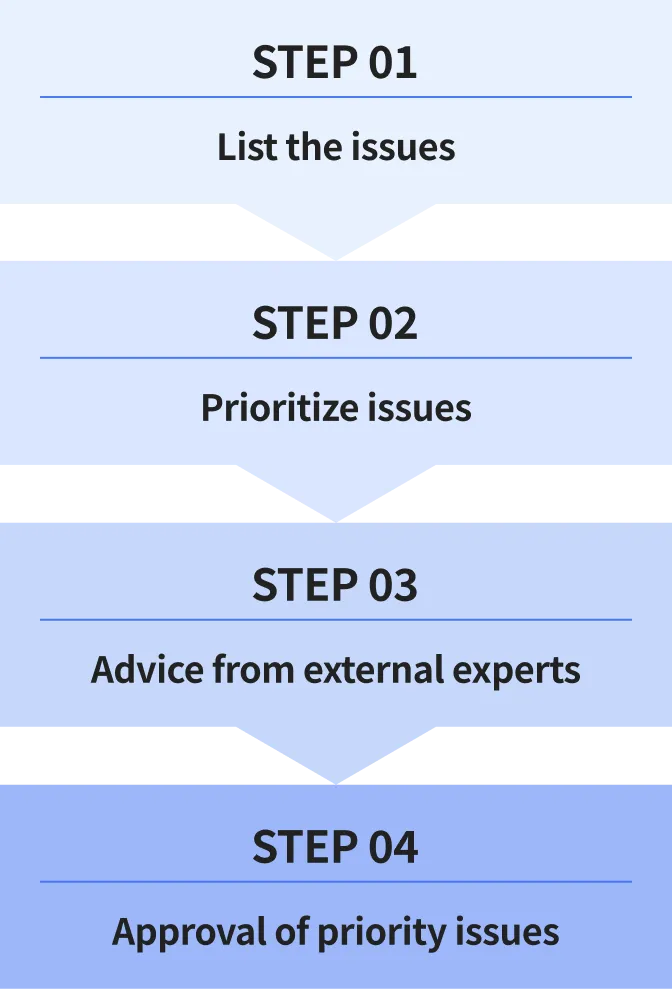
Step 1: List the issues

  • Comprehensive list of sustainability issues based on international frameworks such as GRI standards, SASB, and ESG rating assessment items
  • Extract items from the list of issues that are particularly relevant to the Sapporo Group business type and format

Step 2: Prioritize issues

  • Based on the issues identified, score the degree of impact of the business on society and the environment and the degree of impact of society and the environment on our finances from the aspect of risk and opportunity for each business
  • Prioritization at Sapporo Holdings and major operating companies based on relevance to vision and management strategy

Step 3: Advice from external experts

  • Dialogues with external experts from both the investor and multi-stakeholder perspectives were held to obtain objective advice on priority issues

External experts who participated in the dialogues

  • Mr. Minoru Matsubara, Executive Officer and General Manager of Responsible Investment Division, Resona Asset Management Co., Ltd.
  • Ms. Makiko Akabane, CSR Asia Japan Representative

In addition to the assessment that we have captured important issues in the Group business, we have received the following perspectives.

  • Linkage between business strategy and sustainability material issues
    • Implications of each issue for business development using natural capital
    • Financial implications in terms of both risks and opportunities
  • The importance of clearly stating the Group specific efforts to address each issue
    • Value of raw materials, regional initiatives, etc.
    • Disclosure of specific strategies for human capital

Step 4: Approval of priority issues

  • Approval of the final identified material issues by the Management Council and the Board of Directors

Sustainability Implementation Structure

Sapporo Group has established a Group Sustainability Committee, chaired by the President and representative director of the Company, as an organization that formulates an overall policy for the promotion of the Group sustainability activities and ensures cooperation and coordination within the Group.

The Corporate Planning Department of Sapporo Group develops and implements various measures to promote sustainability activities in each Group company, and works with sustainability personnel at operating companies to share information and confirm progress.

Group Sustainability Committee

  • Meetings are basically held twice a year
  • Main topics of discussion
    • Monitoring of the performance against the sustainability material issues
    • Review of strategies and policies for each issue
  • Discussions, resolutions, reports, etc. at the Management Council and Board of Directors meetings according to the agenda